12.9.12

Damn your low fat diet: How a reformed vegan John Nicholson gorges on all the foods his granny enjoyed... and has never felt better | Mail Online


By John Nicholson


As the kitchen filled with the smell of caramelised meat, my mouth watered in anticipation of the coming feast: a thick cut of tender steak, fried in butter and olive oil. 

This was not a regular treat. In fact, for the previous 26 years I’d been a vegan, eschewing not just meat but all animal products. 

My diet was an extreme version of the NHS Eat Well regime, which recommends lots of starchy foods and smaller quantities of saturated fats, cholesterol, sugar and red meat. 

In 2010, John Nicholson decided to give up my supposedly healthy lifestyle and embrace good old-fashioned meat

According to government advice, I was doing everything right — and yet my health had never been worse. My weight had crept up over the years, until in 2008 I was 14½ stone — which is a lot of blubber for someone who is 5ft 10in — and was classified as clinically obese. 

I waddled around, sweating and short of breath, battling extremely high cholesterol and suffering from chronic indigestion. I was always tired and needed to take naps every afternoon. I had constant headaches and swallowed paracetamol and sucked Rennies like they were sweets.
Worst of all, I had irritable bowel syndrome (IBS), which left me feeling as if I had lead weights in my gut. My belly was bloated and distended after every meal. I was, to use a technical term, knackered.

But that was about to change. In 2010, I decided to give up my supposedly healthy lifestyle and embrace good old-fashioned meat.
From that day on, I ate red meat four or five days a week. I gobbled the fat on chops, chicken skin and pork crackling. I feasted on everything we’re told to avoid. The effects were instant.

Twenty-four hours after eating meat again, all my IBS symptoms had gone. As the weeks and months passed, every aspect of my health improved dramatically. I became leaner, shedding body fat and becoming stronger and fitter. My headaches went away, never to return. Even my libido increased.
It felt like being young again, like coming back to life. But though I felt energised, I was also furious. 

John Nicholson
John Nicholson
Diet swap: John was fat and ill as a vegan, left, but is now the picture of health as a meat eater, right

Furious with myself for sticking to the ‘healthy’ eating advice, which was actually far from a sensible diet. But also furious with the so-called experts who have been peddling this low-fat, high-carbohydrate claptrap for so long that no one thinks to question it. 

My maternal grandmother would certainly have challenged it. Like my grandfather, she was born into a poor family in East Yorkshire at the turn of the century and their eating regime was simple: meat and at least two vegetables at every meal, lots of butter and full-cream milk (they would have scorned yogurt as little more than ‘off’ milk), bread, potatoes, cake and puddings.

'Twenty-four hours after eating meat again, all my IBS symptoms had gone.'
Nothing would have swayed them from that lifestyle. Had a low-fat diet been suggested by a doctor, Gran would have told him to his face that it was all rubbish and that you needed fat to ‘keep the cold out’. 

If she could have seen people buying skimmed milk today, she would have thought they had lost their minds. Getting rid of the best bit of milk? Lunacy.
Late in her life, I recall her scorning the advice on limiting the consumption of eggs because of concerns about cholesterol. On one occasion, she watched in astonishment as a celebrity TV chef made an egg-white omelette. ‘He’s a bloody fool, that man,’ she said.

She was right to be sceptical, it turns out. For years the authorities told us cholesterol-rich foods would kill us — but we’ve since learned that is utter drivel. 

While Ancel Keys, the scientist whose research in the Fifties first raised concerns about cholesterol levels, suggested that heart disease was linked to large amounts of cholesterol in the blood, he never claimed those levels were linked to the amount of cholesterol we eat.

‘There’s no connection whatsoever between cholesterol in food and cholesterol in blood,’ he said in a magazine article in 1997. ‘And we’ve known that all along.’

Since then, the NHS’s paranoia about cholesterol in food has been replaced by concerns about saturated fat — found in everything from butter, cheese and cream to pies, cakes and biscuits.

They suggest saturated fat increases the risk of heart disease. But this is open to debate. 

France has the lowest rate of death from coronary heart disease in Europe, yet the country has the highest consumption of saturated fats.

Gran survived into her 80s and Grandad into his 70s, despite labouring down the pit his whole working life. Did they achieve this by gobbling low-fat spreads, soya oil or skimmed milk? No, they lived on old-fashioned foods such as butter, lard and beef fat. Indeed, a growing body of opinion suggests that the factory-made products that have replaced these staples — vegetable oils, polyunsaturated margarine and spreads — are the real cause of the degenerative diseases that are so common today.

Findings by the Weston A. Price Foundation, a non-profit-making research organisation in America, show most cases of heart attack in the 20th century were of a hitherto little-known form known as myocardial infarction (MI) — a huge blood clot leading to the obstruction of a coronary artery.

Healthy: The NHS's paranoia about cholesterol in food has been replaced by concerns about saturated fat ¿ found in everything from butter, cheese and cream to pies, cakes and biscuits
Healthy: The NHS's paranoia about cholesterol in food has been replaced by concerns about saturated fat - found in everything from butter, cheese and cream to pies, cakes and biscuits

MI was almost non-existent in the U.S. in 1910 and was causing no more than 3,000 deaths a year by 1930. However, by 1960, there were at least 500,000 MI deaths a year across the country.

It surely can’t be a coincidence that this happened as the U.S. embraced a new diet based on increasingly large portions of highly processed foods and vegetable oils?

Similar changes in the national diet took place in Britain during the early years of my life and I can’t help wondering whether my father might still be alive today if it had not been for this shift.

I grew up in the North-East during the Sixties and had no idea about ‘healthy eating’. Those few people who did fret about their diet were thought of as fussy.

No one thought food was a problem, unless the chip shop ran out of battered sausage on a Friday. We ate suet puddings every week, our bacon and eggs were fried in lard, milk was full-fat — I’m not sure skimmed milk even existed in the Sixties — and we ate eggs every day.

Then, in the Seventies, things changed. We got wealthier and food became cheaper. Mam began buying more cakes and confectionery instead of home-baking. We ate more shop-bought food in general.

She also stopped using lard in the chip pan, opting for Spry Crisp ’n Dry instead. Gran wasn’t pleased. She thought vegetable oil was a new-fangled fad — it was, and that was precisely why Mam liked it. She saw it as moving on, modern and fashionable.

'I grew up in the North-East during the Sixties and had no idea about ‘healthy eating’ 
Dad never did any exercise and drove everywhere in his newly acquired company car. 

More processed food, margarine, sugar and vegetable oil, combined with days spent behind a desk and a wheel, saw him gain a sizeable belly and the apple shape so common today. In 1987, he died of a massive heart attack, aged just 65.

His diet in his later years was not one that would have appealed to Gran. She was vehemently against margarine.

‘I’m not eating anything made in a factory,’ she’d say. ‘You don’t know what they put in it.’

It was a fear shared by many of her era. Had I heeded such warnings, I would have avoided my battle with processed food, in the form of soya, the bean whose industrially produced extracts are marketed as a low-fat and exceptionally healthy source of protein.

Today, soya is everywhere. About two-thirds of all processed food in the U.S. contains some form of it.That percentage will not be much different here — you’d be amazed at how often you eat ‘hidden’ soya. 

When my partner, Dawn, and I decided to become vegan during the Eighties, it was still rare in Britain. This lifestyle shift came about shortly after we’d left Newcastle Polytechnic and moved to live self-sufficiently in a rented cottage in northern Scotland. 

When one of our chickens became ill, we found it terribly difficult to put it out of its misery and began to doubt whether killing — or eating — animals was for us. 

We didn’t see why someone else should have to do our dirty work for us, so in January 1984 we ate our last bacon sandwiches and embarked on our dramatic lifestyle change.

At about this time, governments in the U.S. and Europe were recommending that people cut down on eating animal fats, cholesterol and red meat in favour of more starchy foods, fruit and vegetables and wholegrains.

This new healthy eating advice had much in common with the vegetarian diet. We felt we were following a golden path, especially when we discovered the apparent wonders of soya.

In the Sixties people didn't fret about their diet and regularly tucked into food like fish and chips, suet puddings and bacon and eggs fried in lard

Only later did we discover that research by the Weston A. Price Foundation had suggested that processed soya foods are rich in chemicals called trypsin inhibitors, which disrupt protein digestion. I believe it was these that created all my problems with IBS.

Soya has also been associated with hypothyroidism, or an under-active thyroid, a condition whose symptoms include unexplained weight gain, lack of energy and depression — all problems that Dawn began to experience. These problems were exacerbated by other health problems caused by our diet. 

As voracious consumers of nuts, pulses and wholegrains, our diet was very high in copper and, because of the lack of animal protein, low in zinc. Some researchers have linked this imbalance to constant feelings of fatigue, something with which Dawn and I were all too familiar.

For years, we gave the NHS every chance to find out what was wrong with us and get us well. But doctors didn’t and couldn’t — perhaps because they wouldn’t even consider that our apparently healthy diet might be the problem.
Finally, in desperation, Dawn suggested we should try eating meat again. At the same time, we cut out all vegetable oils, except olive oil, and ate lots of lard, beef dripping, butter, cream and full-fat milk.

We have also cut out starchy carbohydrates such as bread, which contains a component of starch that causes blood sugar levels to peak and trough, leading to a cycle of hunger and over-eating.

Admittedly, the absence of bread is one aspect of our new diet that might have caused Gran to ask if I had gone ‘soft in the ’ead’. In her day, they needed lots of carbohydrates to fuel their physically demanding lives, but we are far more sedentary. 

But I’m sure she would have approved of everything else about our new diet because her generation knew how to eat properly. That’s a skill we have forgotten, brain-washed as we are by government and medical propaganda.
It’s time we reminded ourselves of it, questioning the one-size-fits-all, ‘healthy’ eating advice we’re spoon-fed and opting instead for wholesome, unprocessed, home-made food.

Adapted from The Meat Fix, by John Nicholson (Biteback, £12.99). © 2012 John Nicholson. To order a copy for £10.99 (including P&P), tel: 0843 382 0000.

16.8.12

Course:FNH200 - University of British Columbiai

Course:FNH200 - UBC Wiki


Course:FNH200

FNH200
Exploring our Foods
FNH200 Cover.jpg
Course Info
Instructor: Judy Chan
Class schedule: Term 2: M W F 12-1pm
Classroom: MacMillan 166
Office hours: By Appointment
Course Syllabus: FNH200 2011w (pdf)
Course Lessons
Team Projects
Lecture Notes

Course Description

Students are introduced to chemical and physical properties of foods; issues pertaining to safety; nutritive value and consumer acceptability of food, food quality and additives; food preservation techniques and transformation of agricultural commodities into food products; foods of the future.
This course is required in the Food, Nutrition and Health Program and will also be of value to students in other programs in the Faculty of Land and Food Systems, or in other disciplines including those in the life sciences, health care professions, human kinetics or physical education, who wish to enhance their understanding of the science of food.

Course Objectives

After completing this course, successful students will be able to:

  • Describe tissue-based (both plant and animal) food systems, fluid food systems and various dispersions important to food quality;
  • Develop personal food selection and food handling habits that will minimize your risk of contracting food-borne or water-borne disease;
  • Illustrate the importance and role of chemical reactions, enzymes and micro-organisms in food spoilage, food preservation and food-borne disease;
  • Describe various types of food processing and packaging systems;
  • Understand the need for and appropriate applications of food processing;
  • Rationalize and articulate a personal set of values related to your decisions pertaining to selection of food products for your personal and/or your family's consumption


FNH 200 102 2011 Winter

Course Syllabus: File:FNH 200 102 2011w Course Syllabus.pdf

Note to students enrolled in FNH 200:

There are multiple sections for FNH 200. This Course Wiki is developed by Judy Chan for students registered in FNH 200 102. Other instructors may have minor changes in their course content and use different evaluation strategies. Students registered in other sections should contact their instructors for specific information.


  • FNH 200 101 (Term 1): Azita Madadi-Noei
  • FNH 200 102 (Term 2): Judy Chan
  • FNH 200 99A (Distance Education, Term A): Andrea Liceaga
  • FNH 200 99B (Distance Education, Term A): Guangtao Meng
  • FNH 200 99C (Distance Education, Term A): Azita Madadi-Noei
  • FNH 200 99D (Distance Education, Term A): Nooshin Alizadeh-Pasdar
  • FNH 200 99E (Distance Education, Term C): Andrea Liceaga
  • FNH 200 99F (Distance Education, Term C): Azita Madadi-Noei
  • FNH 200 99G (Distance Education, Term C): Guangtao Meng
  • FNH 200 99H (Distance Education, Term C): Nooshin Alizadeh-Pasdar

8.8.12

Soft drinks are 'evil' and should be avoided

Soft drinks are 'evil' and should be avoided


By Kerry Warren
Friday, August 3, 2012


Facebook

116


Email


Pinterest

1


Share

117
Fizzy drinks are 'evil' and should be avoided
A leading researcher has urged people to stop drinking fizzy beverages immediately or risk serious health problems. 

Dr Hans-Peter Kubis has just finished a study of how soft drinks affect our bodies and has reached some shocking conclusions.
Kubis has now sworn off "evil" fizzy drinks, and thinks everyone else should do the same.

Related: Sugary drinks bad for kids' hearts

"Having seen all the medical evidence, I don't touch soft drinks now," Kubis said. "I think drinks with added sugar are, frankly, evil."

Kubis and his team from Bangor University found that as little as two cans of soft drink a week can wreak havoc on our health.

Previous studies have suggested that even moderate consumption appeared to increase the risk of heart disease, liver failure, pancreatic cancer and hypertension.

Kubis' study — published this week in European Journal of Nutrition — found that such drinks might also alter our metabolisms so we rapidly gain weight.

The study concluded that sugary drinks can change the way we burn fat, making our muscles more inclined to burn sugar instead.

This results in weight gain and a reduced ability to regulate blood sugar, increasing the risk of type 2 diabetes.

Australian researcher Dr Bamini Gopinath from Sydney University's Westmead Millennium Institute for Medical Research conducted a study investigating the link between soft drink consumption and heart disease in children.

He has also stopped consuming soft drink as a result of his research, and thinks other Australians should too.

"I'm not sure if they are 'evil' but there's certainly no nutritional value in drinking soft drinks," he said.

"They have been associated with so many chronic disease it is best to avoid consuming them. Australians should definitely stop drinking fizzy drinks."

The Australian Beverage Council has rubbished Kubis' study, saying the small sample size and lack of control group make any findings invalid.

"This highly flawed study cannot be used to state that soft drinks are directly responsible for weight gain, diabetes and other chronic health problems," the council's Chief Executive Officer Geoff Parker said.

Related: Fizzy drinks bad for our kids

Parker also rejected claims that soft drink is contributing to the obesity epidemic, saying no one product can be singled out for blame when so many factors contribute to an unhealthy lifestyle.

"People consume many different foods and beverage so no one single food or beverage is responsible for people being overweight," he said.

"All calories count and it is the total diet or overall pattern of foods and beverages eaten that should be the focus of a healthy eating style."

Your say: Are you worried about how much soft drink you consume?

Video: Soft drink warnings

Facebook

116


Email


Pinterest

1


Share

117
Comment guidelines
Avoid using:
  • Personal attacks
  • Irrelevant comments
  • HTML tags
  • Personal information
  • Offensive language
  • Text in ALL CAPITAL LETTERS
See full comment guideline

6.8.12

Chris Masterjohn, PhD – video lecture (& related videos)

Low-Carb Experts: Chris Masterjohn, PhD


Chris Masterjohn 
Chris Masterjohn, PhD Chris’s mission is to promote the truth about cholesterol, the unsung hero of brain and body.  Visit Chris’s website at www.Cholesterol-And-Health.com to learn more. Dr. Masterjohn’s videos are broken into five segments. To jump straight to a specific segment please click that link:
Segment 01 Segment 02 Segment 03 Segment 04 Segment 05


Low-Carb Experts: Chris Masterjohn, PhD – Segment One (9:32) return to top


Low-Carb Experts: Chris Masterjohn, PhD – Segment Two (8:55) return to top


Low-Carb Experts: Chris Masterjohn, PhD – Segment Three (9:11) return to top


Low-Carb Experts: Chris Masterjohn, PhD – Segment Four (8:08) return to top


Low-Carb Experts: Chris Masterjohn, PhD – Segment Five (9:08) return to top


Got digestive problems? Take it easy on the veggies.

Got digestive problems? Take it easy on the veggies.


man sitting on toilet with "help" sign

A couple weeks ago I wrote an article called FODMAPS: Could Common Foods Be Harming Your Digestive Health? I described how certain classes of foods, known as FODMAPs, are poorly digested in certain people and can lead to gas, bloating, pain and changes in stool frequency and consistency. Studies have shown that conditions like Irritable Bowel Syndrome (IBS) are associated with FODMAP intolerance, and that a low-FODMAP diet offers relief in a substantial percentage of people with IBS.
Today I’ve got another tip for those of you with digestive issues, including IBS, constipation, diarrhea and acid reflux: eat fewer vegetables.
Yep, that’s right. Fewer vegetables.
How following mainstream advice to eat 6-8 servings of vegetables a day could hurt your gut
Tweet This
Vegetables (as well as some fruits) are often high in insoluble fiber. While soluble fiber can be soothing for the gut, consuming large amounts of insoluble fiber when your gut is inflamed is a little bit like rubbing a wire brush against an open wound. Ouch.
Vegetables that are high in insoluble fiber include:
  • Greens (spinach, lettuce, kale, mesclun, collards, arugula, watercress, etc.)
  • Whole peas, snow peas, snap peas, pea pods
  • Green beans
  • Kernel corn
  • Bell peppers
  • Eggplant
  • Celery
  • Onions, shallots, leeks, scallions, garlic
  • Cabbage, bok choy, Brussels sprouts
  • Broccoli
  • Cauliflower
The vegetables that are high in soluble fiber, but lower in insoluble fiber (and thus tend to be safer for those with gut issues) include:
  • Carrots
  • Winter squash
  • Summer squash (especially peeled)
  • Starchy tubers (yams, sweet potatoes, potatoes)
  • Turnips
  • Rutabagas
  • Parsnips
  • Beets
  • Plantains
  • Taro
  • Yuca
Another helpful tip is to reduce the variety of vegetables you eat at any given meal. Instead of stir-fries with 6 different veggies, have a single steamed or roasted vegetable as a side dish. This works better for most people with gut issues.

But won’t I become deficient in nutrients if I don’t eat tons of veggies?

First of all, I’m not suggesting that you don’t eat these foods at all if you have digestive problems. I’m simply suggesting that you limit them. There are also steps you can take to make these foods more digestible and less likely to cause problems. They include:
  1. Never eat insoluble fiber foods on an empty stomach. Always eat them with other foods that contain soluble fiber.
  2. Remove the stems and peels (i.e. from broccoli, cauliflower and winter greens) from veggies (and fruits) high in insoluble fiber.
  3. Dice, mash, chop, grate or blend high-insoluble fiber foods to make them easier to break down.
  4. Insoluble fiber foods are best eaten well-cooked: steamed thoroughly, boiled in soup, braised, etc; avoid consuming them in stir-fries and if you do eat them raw, prepare them as described in #3 above.
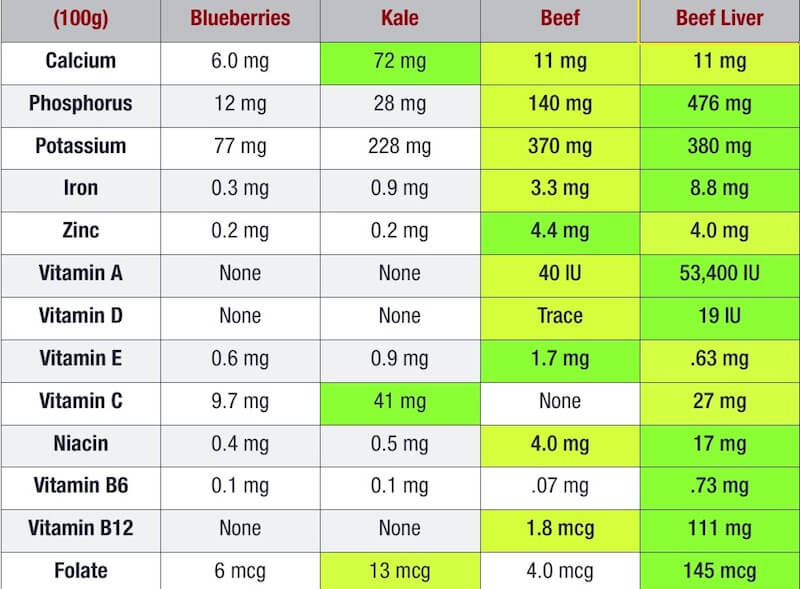
Second, although fruits & veggies are high in certain nutrients, animal products like meat, organ meat, fish, eggs and dairy are as high and sometimes higher in those nutrients. For example, the chart below compares the micronutrient profile of beef liver and beef with blueberries and kale, two plant-foods often referred to as being particularly nutrient-dense:

chart comparing nutrient content of liver, beef, kale & blueberries

It’s also worth pointing out that most traditional cultures only ate a few vegetables and fruits that were available seasonally. They couldn’t walk into Whole Foods and buy every vegetable on the planet at every time of year.

I have nothing against vegetables. In fact, I like them quite a bit and I do think they’re beneficial. But the advice to eat 6-8 servings a day is not based on solid scientific evidence, and may cause unnecessary distress in people with gut problems.

Fermented vegetables: a better alternative?

Fermented vegetables like sauerkraut, kim chi, sauerruben and cortido are excellent alternatives for people with gut issues. First, the fermentation process “pre-digests” the vegetables and makes them easier to absorb. Second, fermented veggies contain probiotic microorganisms that help heal the gut.

Although sauerkraut and kim chi contain cabbage, which is high in insoluble fiber (and a FODMAP to boot), I’ve found that many patients with gut problems can tolerate it quite well. FODMAPs are sugars and sugar alcohols, and fermentation breaks down sugars. This is probably why fermented FODMAPs are better tolerated than non-fermented FODMAPs.
If you’re new to fermented vegetables, you have two options:
  1. Make them yourself. Check out this page for a great primer. It’s really quite easy, and cheap.
  2. You can buy them at a health food store. Make sure that it says “raw” on the jar, and they’re in the refrigerated section. The sauerkraut you can buy in the condiments section has been pasteurized and won’t have the same beneficial effect.
Now I’d like to hear from you: have you tried reducing your intake of vegetables high in insoluble fiber? Did that help your digestion? Let us know in the comments.

P.S. Next week I’ll be presenting at the Ancestral Health Symposium in Boston, and thus may not be able to post an article to the blog. I look forward to meeting those of you that will be there.

Health Correlator: The 14-percent advantage of eating little and then a lot: Putting it in practice


The 14-percent advantage of eating little and then a lot: Putting it in practice

Tuesday, July 31, 2012

Listen to this article. Powered by Odiogo.com In my previous post I argued that the human body may react to “eating big” as it would to overfeeding, increasing energy expenditure by a certain amount. That increase seems to lead to a reduction in the caloric value of the meals during overfeeding; a reduction that seems to gravitate around 14 percent of the overfed amount.

And what is the overfed amount? Let us assume that your daily calorie intake to maintain your current body weight is 2,000 calories. However, one day you consume 1,000 calories, and the next 3,000 – adding up to 4,000 calories in 2 days. This amounts to 2,000 calories per day on average, the weight maintenance amount; but the extra 1,000 on the second day is perceived by your body as overfeeding. So 140 calories are “lost”.

The mechanisms by which this could happen are not entirely clear. Some studies contain clues; one example is the 2002 study conducted with mice by Anson and colleagues (1), from which the graphs below were taken.


In the graphs above AL refers to ad libitum feeding, LDF to limited daily feeding (40 percent less than AL), IF to intermittent (alternate-day) fasting, and PF to pair-fed mice that were provided daily with a food allotment equal to the average daily intake of mice in the IF group. PF was added a control condition; in practice, the 2-day food consumption was about the same in AL, IF and PF.

After a 20-week period, intermittent fasting was associated with the lowest blood glucose and insulin concentrations (graphs a and b), and the highest concentrations of insulin growth factor 1 and ketones (graphs c and d). These seem to be fairly positive outcomes. In humans, they would normally be associated with metabolic improvements and body fat loss.

Let us go back to the 14 pe