
Kurt Harris MD
FATS AND OILS - LIPIDS
Lipids are fatty acids or compound molecules composed of them. A fat is solid at room temperature and oils are liquid. Lipids are the key to PaNu. It is as much our misunderstanding of lipids as our misguided attachments to grains and fructose that is wreaking havoc with our health.
Saturated fat (SFA)
Saturated fats are generally solid at room temperature. Their saturation with hydrogen atoms makes them solid at room temperature as it affects the shape of the molecules as they pack together. This same saturation means they lack a reactive double bond between carbon atoms. In future posts, I will describe how this makes them less susceptible to oxidation, and therefore less likely to promote coronary disease and other diseases.
SFA does not cause heart disease or cancer and does not make you fat. To the contrary, the hormonal satiety and lack of insulin response from eating fats is the key to weight optimization and avoiding the diseases of civilization caused by hyperinsulinemia and high blood glucose levels - diabetes, metabolic syndrome, degenerative diseases like alzheimer dementia, and many of the commonest cancers.
Think of saturated fat as “anti- fructose” – they are both completely “natural”, but in a modern food abundant environment, SFA is healthy matter and fructose is evil anti-matter. This is the subject of future posts, but it involves satiety and the metabolic meaning of availability of these two food types.
MUFAs – Monounsaturated fatty acids
A monounsaturated fat (MUFA) has a single carbon- carbon double bond. MUFAs have some unique properties in the diet. Their best known source is olive oil, but they are quite abundant in animal fats.
PUFAs – Polyunsaturated fatty acids.
These are fatty acids that have multiple reactive carbon-carbon double bonds. They occur with varying chain lengths but are generally classed by where the first double bond occurs from the end of the molecule, in the Omega 6 position or the Omega 3 position, abbreviated as N-6 and N-3. Much of the biological significance of N-6 and N3 fatty acids relates to their ratio, as they are the precursors for signaling molecules called eicosanoids that affect immune function, among other things. Excess O-6s compete for an enzyme that O-3 metabolism uses as well, and in turn this affects eicosanoid ratios in the body. Both O-6 and O-3 fatty acids are more susceptible to oxidation due to their multiple unsaturated carbon-carbon double bonds, and this also has biological significance, particularly in the process of atherosclerosis.
THE PANU METHOD APPLIED TO OILS
The evolutionary principle would suggest that once we think there might be harm from a particular artificial food, like an oil mechanically extracted from a seed or a nut, we should look for evolutionary discordance or concordance - could humans have eaten it in those amounts?
The method of PaNu is to first use modern tools and reasoning to think about what foods might not be working for us. Then, we mine the past to see if that food shows evidence of evolutionary discordance.
Grains and seed oils - corn, safflower, cotton, peanut, canola, flaxseed (linseed) all fail this test, mostly due to excess N-6 PUFA content.
Step 1: We observe evidence of harm with excess N-6 consumption when we understand the enzyme pathways of eicosanoid production, competitive inhibition of N-3 elongation by excess N-6s, and epidemiologic evidence that shows coronary disease and cancer tracking industrial oil consumption. I have not fully elaborated all these data and arguments yet, but this is where the argument begins.
Step2: Humans could not have had a metabolism dominated by huge amounts of N-6's in the paleolithic period as it would have required industrial technology that did not exist. The predominance of N-6's in our diet comes from mechanical extraction from seed oils. Absent this technology, a human could never get more than a trivial fraction of the N-6s we consume in out modern industrial diets.
Step 2 explains and strengthens our understanding of Step 1 and establishes presumptive evolutionary discordance.
Conclusion: excess seed oil consumption deviates from the EM2.
PaNu suggests we prefer SFA and MUFAs , then minimize overall PUFAs with a ratio appropriate to the EM2. A ratio of N-6:N-3 close to 2:1 is desirable, which suggests complete avoidance of mechanically extracted vegetable oils high in N-6, and if necessary, compensatory supplementation with N-3s via fish or fish oil.
It seems best to limit O-6's to less than 4% of calories - I just calculated mine at 2.75%. See Stephan's post here and some of his other posts for a good discussion of this. If you are above 4% O-6 then supplementing to get to 1% O3 likely has a benefit.
I eat sardines occasionally and I eat cod and non-farmed salmon slathered in butter once a week or so, - I haven't calculated it but I suppose I am getting plenty of 03s without cod liver oil or fish pills.
If you are still getting a lot of seed oils with high O6 levels, you may well need fish oil as a compensatory supplement.
MUFAs AND OLIVE OIL
Olive oil is a bit of a politically correct fad. It has it's origins of course in the supposed mediterranean diet - of which there are several, and of which only some had any olive oil in them. The support for olive oil was the general scheme (not supported by the evidence) that SFA is bad and MUFA and PUFAs were the alternative.
When you eat animal products and have low carbohydrate intake, you are getting huge amounts of MUFA from the animal fat - check out the MUFA content in a steak or in butter and it nearly matches the sat fat. Bone marrow is the big evolutionary source of MUFAs, not cold pressed olive oil. Of course there is some oxidation going on when you cook with olive oil that will defeat the purpose, so I eat it cold for flavor, but I get plenty of MUFA without olive oil in my animal based diet.
NUTS AND NUT OILS
How about nuts? I started out a big nut eater, thinking they were healthy and natural. I've found that they are loaded with carbs, though, and they seem to disturb my gut if I eat a lot of them, due to some lectins, no doubt. After research about fatty acids, I definitely do not view them in some therapeutic way like many seem to. Indeed, I can't think of any particular reason to eat them except to add flavor and interest to salads and other food -that is how I use them.
Nut Oils? Surely they are safer and better than grass seed oils - I use walnut oil and olive for flavor sometimes. Any advantage over butter or ghee or grass fed tallow or lard?
In my opinion, no. Too many PUFAs in nut oils to prefer them to butter and animal fats. Even if not N-6 predominant, PUFA levels in general should be kept low, and nut oils are high in PUFAs.
Eating nut oils in significant quantity depends on industrial technology not available in paleolithic times. Hence, eating bottled nut oil deviates from the EM2, even if not nearly as significantly as grass seed oils.
To summarize our PaNu hierarchy of fats and oils:
1) SFA is best because it is not oxidizable.
2) MUFA is next
3) Total PUFA should be as low as possible. N3 PUFA supplements are for people with too much N-6 PUFA from seed oils.
Animal sources, preferably grass fed or pastured, are the best way to optimize your lipid intake.
Overall, the biggies for discordance remain:
1 Cereal grains (Lectins, phytates, gliadin proteins)
2 Fructose as a high % of calories in a food abundant environment (Hormonal effects)
3 High N-6 PUFA consumption (imbalanced eicosanoid production with immune dsyfunction, inflammation and cancer promotion)
4 Inadequate animal fat intake might be #5, as it is both the consequence of and much of the solution to 1-3.
My approach remains somewhat that of a finger-wagging killjoy - "don't eat that" is just not as much fun as "eat this magic pill or supplement and you'll be healthier" and I am sure that's not the way to sell the most books. It also won't help you much if you are marketing supplements or expensive drugs. If you don't already like meat, seafood, eggs, cream and butter, there is not much emotional upside to my approach. It's not really that exciting to say "Hey, guess what I don't eat!" Even were you to show up naked to a party, you simply could not be more of a social freak than to refuse bread, beer, crackers, chips, and a slice of your neighbor's kid's birthday cake, and eat your burger rolled up like a tortilla with cheddar cheese and a slice of tomato.
But, there it is. If we are not in the business of marketing or politics, we must go where the evidence leads us.


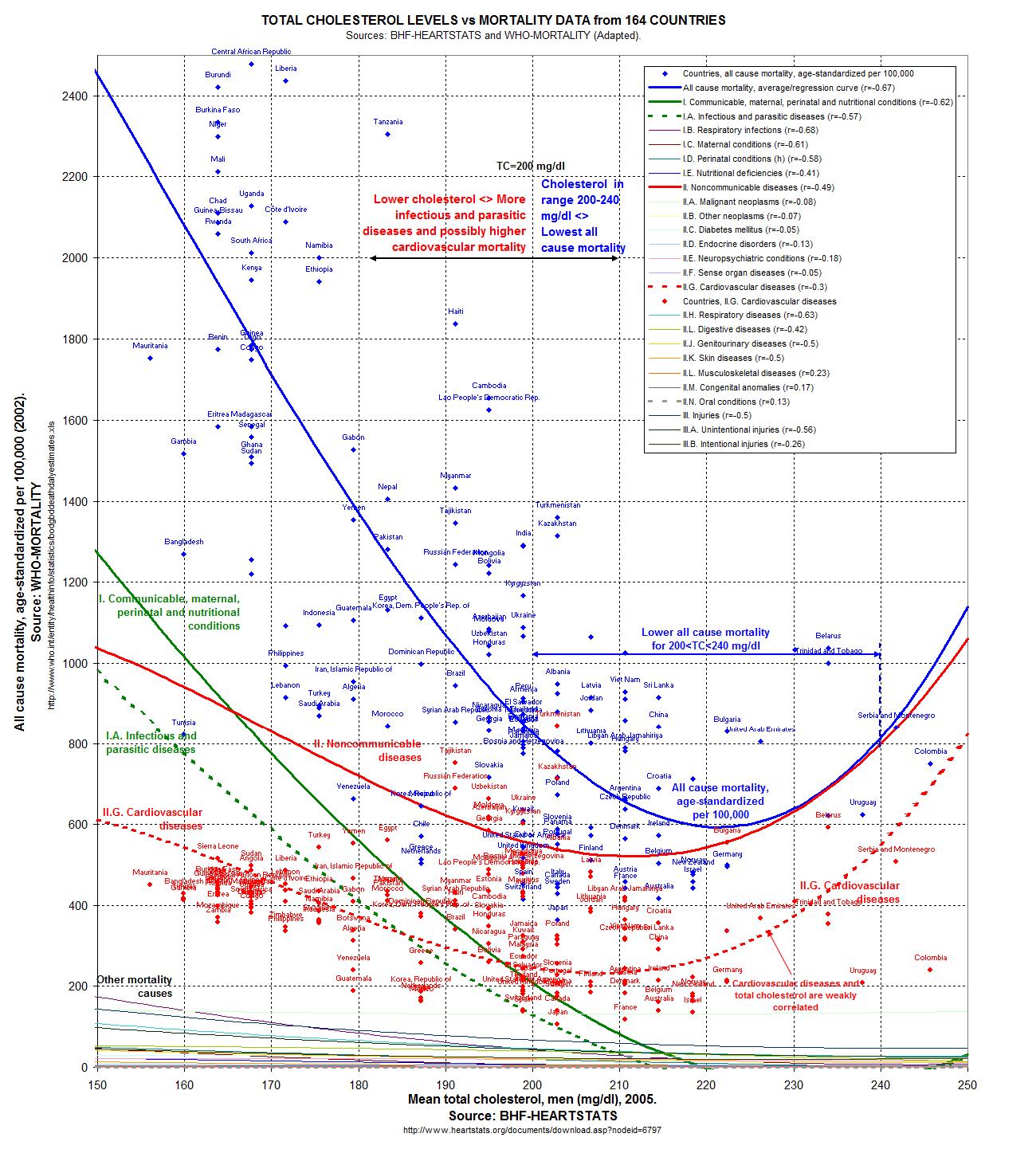

http://westonaprice.org/moderndiseases/benefits_cholest.html
And as Mary Enig says, a total blood lipoprotein count between 200 and 240 is normal, not a disease process.
http://westonaprice.org/knowyourfats/fats_phony.html
In any population, all measurable characteristics vary within a normal range in a Bell Curve fashion. Just as some people are shorter than average and some taller than average, some have smaller and some have larger feet, and some have lower and some have higher total lipoproteins. Thus, "high" cholesterol is not by itself indicative of a disease process any more than above average height indicates a disease process.
I have read that taller people have, in general, a lower life expectancy than shorter people (don't have the reference). Assuming this is true, it would not give warrant for height reduction surgery for taller than average people. Similarly, even if it could be demonstrated that people with lower total lipoprotein counts did live longer, that would not give warrant to subject individuals with "above average" total lipoprotein counts to artificial cholesterol reduction.
This gets back to the whole issue of reductionism. Tim's doctor thinks a blood cholesterol of 226 is a disease process. He completely ignores the context (patient) in which this occurs. Rather than evaluating the patient, he reduces the patient to a lab number. He wants to treat the cholesterol, not the patient.
Don