....as discussed in Peat vs. Paleo - The Danny Roddy Weblog - Animal-Based Nutrition
Ray Peat on dietary sucrose:
Paleo advocates recommend lower carb diets. Sisson recommends 150 grams (or less) of carbohydrates a day, while others recommend ketogenic levels (50g or less). This is the greatest departure Ray Peat makes from the typical paleo diet.
He states that sugar (sucrose, fructose) is not an issue when polyunsaturated fats are not in the diet.
Showing posts with label fat - polyunsaturated. Show all posts
Showing posts with label fat - polyunsaturated. Show all posts
2.7.11
Ray Peat - evils of unsaturated fatty acids
Discusses links between unsaturated fatty acids (UFA) and:
- hypothyroidism
- heart disease
- immunosuppression
- cancer
- brain dysfunction (via UFA peroxidation)
- obesity
Notable mentions:
- nutrition in fish heads
- 600 day half life of dangerous UFA in human tissue
- theory that there is no essential dietary fatty acids for humans

Coconut Oil - mechanisms and more, Ray Peat
Coconut Oil by Ray Peat Phd
Extracts:
Coconut oil is unusually rich in short and medium chain fatty acids. Shorter chain length allows fatty acids to be metabolized without use of the carnitine transport system. Mildronate, which I discussed in an article on adaptogens, protects cells against stress partly by opposing the action of carnitine, and comparative studies showed that added carnitine had the opposite effect, promoting the oxidation of unsaturated fats during stress, and increasing oxidative damage to cells. I suspect that a degree of saturation of the oxidative apparatus by short-chain fatty acids has a similar effect--that is, that these very soluble and mobile short-chain saturated fats have priority for oxidation, because they don't require carnitine transport into the mitochondrion, and that this will tend to inhibit oxidation of the unstable, peroxidizable unsaturated fatty acids.
While components of coconut oil have been found to have remarkable physiological effects (as antihistamines, antiinfectives/antiseptics, promoters of immunity, glucocorticoid antagonist, nontoxic anticancer agents, for example), I think it is important to avoid making any such claims for the natural coconut oil, because it very easily could be banned from the import market as a "new drug" which isn't "approved by the FDA." We have already seen how money and propaganda from the soy oil industry eliminated long-established products from the U.S. market. I saw people lose weight stably when they had the habit of eating large amounts of tortilla chips fried in coconut oil, but those chips disappeared when their producers were pressured into switching to other oils, in spite of the short shelf life that resulted in the need to add large amounts of preservatives. Oreo cookies, Ritz crackers, potato chip producers, and movie theater popcorn makers have experienced similar pressures.
The cholesterol-lowering fiasco for a long time centered on the ability of unsaturated oils to slightly lower serum cholesterol. For years, the mechanism of that action wasn't known, which should have suggested caution. Now, it seems that the effect is just one more toxic action, in which the liver defensively retains its cholesterol, rather than releasing it into the blood. Large scale human studies have provided overwhelming evidence that whenever drugs, including the unsaturated oils, were used to lower serum cholesterol, mortality increased, from a variety of causes including accidents, but mainly from cancer.
Extracts:
Coconut oil is unusually rich in short and medium chain fatty acids. Shorter chain length allows fatty acids to be metabolized without use of the carnitine transport system. Mildronate, which I discussed in an article on adaptogens, protects cells against stress partly by opposing the action of carnitine, and comparative studies showed that added carnitine had the opposite effect, promoting the oxidation of unsaturated fats during stress, and increasing oxidative damage to cells. I suspect that a degree of saturation of the oxidative apparatus by short-chain fatty acids has a similar effect--that is, that these very soluble and mobile short-chain saturated fats have priority for oxidation, because they don't require carnitine transport into the mitochondrion, and that this will tend to inhibit oxidation of the unstable, peroxidizable unsaturated fatty acids.
While components of coconut oil have been found to have remarkable physiological effects (as antihistamines, antiinfectives/antiseptics, promoters of immunity, glucocorticoid antagonist, nontoxic anticancer agents, for example), I think it is important to avoid making any such claims for the natural coconut oil, because it very easily could be banned from the import market as a "new drug" which isn't "approved by the FDA." We have already seen how money and propaganda from the soy oil industry eliminated long-established products from the U.S. market. I saw people lose weight stably when they had the habit of eating large amounts of tortilla chips fried in coconut oil, but those chips disappeared when their producers were pressured into switching to other oils, in spite of the short shelf life that resulted in the need to add large amounts of preservatives. Oreo cookies, Ritz crackers, potato chip producers, and movie theater popcorn makers have experienced similar pressures.
The cholesterol-lowering fiasco for a long time centered on the ability of unsaturated oils to slightly lower serum cholesterol. For years, the mechanism of that action wasn't known, which should have suggested caution. Now, it seems that the effect is just one more toxic action, in which the liver defensively retains its cholesterol, rather than releasing it into the blood. Large scale human studies have provided overwhelming evidence that whenever drugs, including the unsaturated oils, were used to lower serum cholesterol, mortality increased, from a variety of causes including accidents, but mainly from cancer.
1.7.11
Saturated fat Study (1997) - An Example of Junk Science
Low Carbohydrate Nutrition: An Example of Junk Science
Extract:
While the establishment is finally recognizing the dangers of trans fatty acids, conventional dietary gurus continue to warn the public about the alleged dangers of saturated fats.
In this article, we will look at a study published in 1997 in the American Journal of Cardiology (79:350-354) used to justify avoidance of red meat and butterfat, the two main sources of saturated fatty acids in the Western diet.
Arthur Agatston, author of the best-selling South Beach Diet refers to this research when he states:
In the study, carried out by Robert A. Vogel and his team at the University of Maryland School of Medicine, ten volunteers were tested for "endothelial function" by measuring.....[ ].
But was it saturated fat that caused the decline in endothelial function?
The high-fat meal consisted of an egg McMuffin, sausage McMuffin, two hash brown patties and a noncaffeinated beverage. The lowfat meal consisted of Frosted Flakes, skimmed milk and orange juice. According to the authors, the high fat meal contained 50 grams of fat, of which 14 were saturated fat. So only 28 percent of the fat in the high-fat meal was saturated. The rest was a combination of trans fats, monounsaturated and polyunsaturated fat, any one of which, or all together are the likely culprits in the decline in endothelial function.
But Agatston (along with the study authors) blames the adverse effects on saturated fats!
Extract:
An Example of Junk Science
By Mary Enig PhdWhile the establishment is finally recognizing the dangers of trans fatty acids, conventional dietary gurus continue to warn the public about the alleged dangers of saturated fats.
In this article, we will look at a study published in 1997 in the American Journal of Cardiology (79:350-354) used to justify avoidance of red meat and butterfat, the two main sources of saturated fatty acids in the Western diet.
Arthur Agatston, author of the best-selling South Beach Diet refers to this research when he states:
"The major problem I have with the Atkins Diet is the liberal intake of saturated fats. There is evidence now that immediately following a meal of saturated fats, there is dysfunction in the arteries, including those that supply the heart muscle with blood. As a result, the lining of the arteries (the endothelium) is predisposed to constriction and clotting. Imagine: Under the right (or rather, wrong) circumstances, eating a meal that’s high in saturated fat can trigger a heart attack! In addition, after a high-fat meal certain elements in the blood called remnant particles, persist for longer than is healthy. These particles contribute to the buildup of plaque in the vessel wall."Agatston recommends consuming polyunsaturated and monounsaturated vegetable oils, including tub spreads, rather than animal fats like butter.
In the study, carried out by Robert A. Vogel and his team at the University of Maryland School of Medicine, ten volunteers were tested for "endothelial function" by measuring.....[ ].
But was it saturated fat that caused the decline in endothelial function?
The high-fat meal consisted of an egg McMuffin, sausage McMuffin, two hash brown patties and a noncaffeinated beverage. The lowfat meal consisted of Frosted Flakes, skimmed milk and orange juice. According to the authors, the high fat meal contained 50 grams of fat, of which 14 were saturated fat. So only 28 percent of the fat in the high-fat meal was saturated. The rest was a combination of trans fats, monounsaturated and polyunsaturated fat, any one of which, or all together are the likely culprits in the decline in endothelial function.
But Agatston (along with the study authors) blames the adverse effects on saturated fats!
Bacon - 60% PUFA (Wikipedia), and heart disease connection
Bacon - Wikipedia, the free encyclopedia
Researchers from the Harvard School of Public Health found in 2010 that eating processed meats such as bacon, preserved by smoking, curing or salting, or with the addition of chemical preservatives, was associated with an increased risk of both heart disease and diabetes.
The same association was not found for unprocessed meat.[38]
Nutrients
Four 14-gram (0.5 oz) slices of bacon together contain 7.45 grams (0.26 oz) of fat, of which about half is monounsaturated, a third is saturated and a sixth is polyunsaturated, and 7.72 grams (0.27 oz) of protein.[35] Four pieces of bacon can also contain up to 800 mg of sodium, which is roughly equivalent to 1.92 grams of salt. The fat and protein content varies depending on the cut and cooking method.Health concerns
A 2007 study by Columbia University suggests a link between eating cured meats (such as bacon) and chronic obstructive pulmonary disease. The preservative sodium nitrite is the probable cause,[36][37] and bacon made without added nitrites is available. Bacon is usually high in salt and saturated fat; excessive consumption of both is related to a variety of health problems. See the articles on saturated fat and salt for more details.Researchers from the Harvard School of Public Health found in 2010 that eating processed meats such as bacon, preserved by smoking, curing or salting, or with the addition of chemical preservatives, was associated with an increased risk of both heart disease and diabetes.
The same association was not found for unprocessed meat.[38]
Unsaturated vegetable oils toxic - Ray Peat Phd
Coconutoil.com - UNSATURATED VEGETABLE OILS: TOXIC
SUMMARY
- Unsaturated fats cause aging, clotting, inflammation, cancer, and weight gain.
- Avoid foods which contain the polyunsaturated oils, such as corn, soy, safflower, flax, cottonseed, canola, peanut, and sesame oil.
- Mayonnaise, pastries, even candies may contain these oils; check the labels for ingredients.
- Pork is now fed corn and soy beans, so lard is usually as toxic as those oils; use only lean pork
- Fish oils are usually highly unsaturated; "dry" types of fish, and shellfish, used once or twice a week, are good
- Avoid cod liver oil.
- Use vitamin E.
- Use coconut oil, butter, and olive oil
- Unsaturated fats intensify estrogen's harmful effects.
Lard versus olive oil - Paleo forum discussion (...all day everyday?)
bacon all day everyday?
I think they are being very selective about the information they are presenting in that comparison.
In terms of polyunsaturated fats, yes, commercial bacon fat - and in fact all fat from commercial pigs - is similar to olive oil. However, contrary to their scare tactics on polyunsaturated fats, that's because both are fairly low in polyunsaturated fats, and both have reasonable albeit not great omega 3:6 ratios - that's why olive oil is often regarded as the least bad of nonpaleo oils. They also neglect to mention that the fat that actually stays on the bacon is the fat that hasn't gotten hot enough to melt off, so it's far from the temperatures required for oxidation - and if you cook bacon correctly, over low heat, the fat that melts out doesn't get to those temperatures either.
Polyunsaturated fats are only part of the picture, though. Saturated fat is also important, because the saturation of fat is strongly related to cooking stability. The article leaves out the fact that pork fat has about three times the saturated fat of olive oil, a major difference. That's what makes pork fat so much stabler when used as cooking oil, a difference with which I've had plenty of personal experience. They also leave out the smoke points - 370F for lard, 320F for extra virgin olive oil.
And of course, all that neglects the fundamental argument for paleo: it protects us against the problems we don't know about, not just the problems we do know about. Pigs on the hoof are delicious and were eaten by paleolithic humans.
Now, is grass finished beef tallow even better for cooking? In terms of omega 3:6 ratios, it's certainly better than commercial pork fat. On the other hand, I've found even grass finished beef tallow to be a little too saturated to be ideal for some cooking applications.
Extract:
Some authors, including the highly-respected Dr. Michael Eades, compare the fatty acid profile of bacon to olive oil and conclude that they are very similar. A few percentage points of monounsaturated fat (MUFA) or saturated fat (SFA) aside, we’ll agree. Furthermore, the total polyunsaturated fat (PUFA) content of bacon fat and olive oil are almost identical. (Weird, right?) So here’s where we come back to having a consistent thought process for our recommendations.
We generally recommend against cooking with olive oil… so why would we champion cooking with bacon?
Here’s the back-story. We (and lots of Smart People like Chris Kresser and Chris Masterjohn ) recommend aggressively limiting your polyunsaturated fat intake because those fragile fats undergo peroxidation most easily (compared to MUFA and SFA). The oxidation process forms damaging free radicals that promote inflammation, contribute to aging, and increase the risk of cancer. Heating these fats and exposing them to air (oxygen) dramatically increases the rate that these fats oxidize. So, logically, we recommend that you avoid heating or cooking with fats (like olive oil) that contain these fragile, prone-to-oxidation PUFAs.
So if we believe olive oil should not be heated, and bacon and olive oil have almost the same PUFA content, why would we portray bacon as a healthy choice, given that no one eats their bacon carpaccio-style? Bacon is generally cooked in the open air at fairly high temperatures until “well done”, which smells like oxidized PUFA to us. (And given that their PUFA profile is practically identical, it also doesn’t make sense for us to recommend against cooking with olive oil, but then to give cooking with bacon fat the green light.)
The kicker is that the amount of total fat (and thus PUFA, as a percentage of the total) in a manly-sized serving of bacon is much greater than you’d get from a tablespoon-sized serving of olive oil. (Remember, it’s not just about the ratio of 6:3 in any given food or meal – it’s more about the total dose.) So dissing EVOO for cooking but crispifying a pound of bacon every morning – or frying all your food in bacon fat – just doesn’t add up to us.
I think they are being very selective about the information they are presenting in that comparison.
In terms of polyunsaturated fats, yes, commercial bacon fat - and in fact all fat from commercial pigs - is similar to olive oil. However, contrary to their scare tactics on polyunsaturated fats, that's because both are fairly low in polyunsaturated fats, and both have reasonable albeit not great omega 3:6 ratios - that's why olive oil is often regarded as the least bad of nonpaleo oils. They also neglect to mention that the fat that actually stays on the bacon is the fat that hasn't gotten hot enough to melt off, so it's far from the temperatures required for oxidation - and if you cook bacon correctly, over low heat, the fat that melts out doesn't get to those temperatures either.
Polyunsaturated fats are only part of the picture, though. Saturated fat is also important, because the saturation of fat is strongly related to cooking stability. The article leaves out the fact that pork fat has about three times the saturated fat of olive oil, a major difference. That's what makes pork fat so much stabler when used as cooking oil, a difference with which I've had plenty of personal experience. They also leave out the smoke points - 370F for lard, 320F for extra virgin olive oil.
And of course, all that neglects the fundamental argument for paleo: it protects us against the problems we don't know about, not just the problems we do know about. Pigs on the hoof are delicious and were eaten by paleolithic humans.
Now, is grass finished beef tallow even better for cooking? In terms of omega 3:6 ratios, it's certainly better than commercial pork fat. On the other hand, I've found even grass finished beef tallow to be a little too saturated to be ideal for some cooking applications.
The Bacon Bummer - Whole9
The Bacon Bummer | Whole9 | Let us change your life.
by Whole9
Extract:
The Bummer Part
You see, bacon, however delicious it might be, has some downsides.
First, factory-farmed bacon (approximately 95% of the bacon purchased in the US, according to 2007 data) is, nutritionally speaking, garbage. It’s the fattiest cut of an inhumanely treated, poorly fed, often sickly animal, and it’s loaded with unhealthy (i.e. contaminated) fats, preservatives and additives. We’d venture to call it toxic meat, but then again, we love hyperbole. Nonetheless, we think nobody should eat factory-farmed bacon – ever.
Even in family farms where the animals are treated well, their diets are not always conducive to our optimal health. Even “pastured” pigs’ diets are often supplemented with corn, grains and soybeans. This makes this kind of pastured pork the equivalent of grain-fed cattle that get to eat a little bit of grass – and we would not designate that meat as optimally healthy for you. Because we believe high-quality, grass-finished, organic meat from ruminants (like beef, lamb and elk) is the most healthy protein source available, promoting lots of lesser quality meats like bacon – even from mostly pastured pork – doesn’t make much sense. (Nonetheless, this is not a case against pork. In a rotation of high-quality meats, 100% pastured, organic pork may have its place.)
So why aren’t we promoting 100% pastured, organic, family-farmed bacon?
Here’s where our experience comes in. Historically, when we give people a nutritional inch, they take a nutritional mile. And like a Paleo version of “telephone”, our message tends to degrade the further it spreads. When we mention that we use 100% egg white powder when we travel, people take that to mean, “It’s okay to drink protein shakes!” We say pastured, organic, clarified butter is a good food choice, they pass along, “Whole9 says eat more butter!” Which is exactly why you’ll never hear us mention bacon.
So if we mentioned 100% pastured, organic, nitrate/nitrite-free , family-farmed bacon in every web article, Facebook post and Twitter tweet, well… readers, followers, and workshop attendees would hear (and tell others), “Whole9 say eat bacon!” And then they’d tell their friends, family members and blog readers to eat more bacon, and then you’ve got a whole group of Paleo newbies buying pounds of Oscar Mayer – and consuming what could, in fact, be the unhealthiest meat product out there (besides Spam) in copious amounts. Oops. So that’s one reason we don’t pimp bacon.
6:3 (You Knew We’d Go There)
Some authors, including the highly-respected Dr. Michael Eades, compare the fatty acid profile of bacon to olive oil and conclude that they are very similar. A few percentage points of monounsaturated fat (MUFA) or saturated fat (SFA) aside, we’ll agree. Furthermore, the total polyunsaturated fat (PUFA) content of bacon fat and olive oil are almost identical. (Weird, right?) So here’s where we come back to having a consistent thought process for our recommendations.
We generally recommend against cooking with olive oil… so why would we champion cooking with bacon?
Here’s the back-story. We (and lots of Smart People like Chris Kresser and Chris Masterjohn ) recommend aggressively limiting your polyunsaturated fat intake because those fragile fats undergo peroxidation most easily (compared to MUFA and SFA). The oxidation process forms damaging free radicals that promote inflammation, contribute to aging, and increase the risk of cancer. Heating these fats and exposing them to air (oxygen) dramatically increases the rate that these fats oxidize. So, logically, we recommend that you avoid heating or cooking with fats (like olive oil) that contain these fragile, prone-to-oxidation PUFAs.
So if we believe olive oil should not be heated, and bacon and olive oil have almost the same PUFA content, why would we portray bacon as a healthy choice, given that no one eats their bacon carpaccio-style? Bacon is generally cooked in the open air at fairly high temperatures until “well done”, which smells like oxidized PUFA to us. (And given that their PUFA profile is practically identical, it also doesn’t make sense for us to recommend against cooking with olive oil, but then to give cooking with bacon fat the green light.)
The kicker is that the amount of total fat (and thus PUFA, as a percentage of the total) in a manly-sized serving of bacon is much greater than you’d get from a tablespoon-sized serving of olive oil. (Remember, it’s not just about the ratio of 6:3 in any given food or meal – it’s more about the total dose.) So dissing EVOO for cooking but crispifying a pound of bacon every morning – or frying all your food in bacon fat – just doesn’t add up to us.
Delicous Isn’t Good Enough.
Our concern is not just with the amount of – or 6:3 ratio of – pastured vs. conventional bacon – it’s not just about the fat. (And we don’t really want to debate the potential harm of nitrates/nitrites that are commonly used to preserve bacon. That smacks of justification.) The final reason we don’t promote bacon is because even if you buy the uncured, organic, 100% pastured, nitrate-free stuff, it’s still not your best protein choice. (It doesn’t even make our Top Ten, in fact.) Amy Kubal, RD, says “Many consider bacon a quality source of protein, but this is not necessarily the case compared to beef or chicken. In fact, bacon is often just as much fat as protein.
Bacon is delicious – don’t get me wrong. It’s my favorite ‘condiment’ and should be treated as just that – a condiment. A slice or two every now and then is great, but as an everyday protein option, you can do better.”
by Whole9
Extract:
The Bummer Part
You see, bacon, however delicious it might be, has some downsides.
First, factory-farmed bacon (approximately 95% of the bacon purchased in the US, according to 2007 data) is, nutritionally speaking, garbage. It’s the fattiest cut of an inhumanely treated, poorly fed, often sickly animal, and it’s loaded with unhealthy (i.e. contaminated) fats, preservatives and additives. We’d venture to call it toxic meat, but then again, we love hyperbole. Nonetheless, we think nobody should eat factory-farmed bacon – ever.
Even in family farms where the animals are treated well, their diets are not always conducive to our optimal health. Even “pastured” pigs’ diets are often supplemented with corn, grains and soybeans. This makes this kind of pastured pork the equivalent of grain-fed cattle that get to eat a little bit of grass – and we would not designate that meat as optimally healthy for you. Because we believe high-quality, grass-finished, organic meat from ruminants (like beef, lamb and elk) is the most healthy protein source available, promoting lots of lesser quality meats like bacon – even from mostly pastured pork – doesn’t make much sense. (Nonetheless, this is not a case against pork. In a rotation of high-quality meats, 100% pastured, organic pork may have its place.)
So why aren’t we promoting 100% pastured, organic, family-farmed bacon?
Here’s where our experience comes in. Historically, when we give people a nutritional inch, they take a nutritional mile. And like a Paleo version of “telephone”, our message tends to degrade the further it spreads. When we mention that we use 100% egg white powder when we travel, people take that to mean, “It’s okay to drink protein shakes!” We say pastured, organic, clarified butter is a good food choice, they pass along, “Whole9 says eat more butter!” Which is exactly why you’ll never hear us mention bacon.
So if we mentioned 100% pastured, organic, nitrate/nitrite-free , family-farmed bacon in every web article, Facebook post and Twitter tweet, well… readers, followers, and workshop attendees would hear (and tell others), “Whole9 say eat bacon!” And then they’d tell their friends, family members and blog readers to eat more bacon, and then you’ve got a whole group of Paleo newbies buying pounds of Oscar Mayer – and consuming what could, in fact, be the unhealthiest meat product out there (besides Spam) in copious amounts. Oops. So that’s one reason we don’t pimp bacon.
6:3 (You Knew We’d Go There)
Some authors, including the highly-respected Dr. Michael Eades, compare the fatty acid profile of bacon to olive oil and conclude that they are very similar. A few percentage points of monounsaturated fat (MUFA) or saturated fat (SFA) aside, we’ll agree. Furthermore, the total polyunsaturated fat (PUFA) content of bacon fat and olive oil are almost identical. (Weird, right?) So here’s where we come back to having a consistent thought process for our recommendations.
We generally recommend against cooking with olive oil… so why would we champion cooking with bacon?
Here’s the back-story. We (and lots of Smart People like Chris Kresser and Chris Masterjohn ) recommend aggressively limiting your polyunsaturated fat intake because those fragile fats undergo peroxidation most easily (compared to MUFA and SFA). The oxidation process forms damaging free radicals that promote inflammation, contribute to aging, and increase the risk of cancer. Heating these fats and exposing them to air (oxygen) dramatically increases the rate that these fats oxidize. So, logically, we recommend that you avoid heating or cooking with fats (like olive oil) that contain these fragile, prone-to-oxidation PUFAs.
So if we believe olive oil should not be heated, and bacon and olive oil have almost the same PUFA content, why would we portray bacon as a healthy choice, given that no one eats their bacon carpaccio-style? Bacon is generally cooked in the open air at fairly high temperatures until “well done”, which smells like oxidized PUFA to us. (And given that their PUFA profile is practically identical, it also doesn’t make sense for us to recommend against cooking with olive oil, but then to give cooking with bacon fat the green light.)
The kicker is that the amount of total fat (and thus PUFA, as a percentage of the total) in a manly-sized serving of bacon is much greater than you’d get from a tablespoon-sized serving of olive oil. (Remember, it’s not just about the ratio of 6:3 in any given food or meal – it’s more about the total dose.) So dissing EVOO for cooking but crispifying a pound of bacon every morning – or frying all your food in bacon fat – just doesn’t add up to us.
Delicous Isn’t Good Enough.
Our concern is not just with the amount of – or 6:3 ratio of – pastured vs. conventional bacon – it’s not just about the fat. (And we don’t really want to debate the potential harm of nitrates/nitrites that are commonly used to preserve bacon. That smacks of justification.) The final reason we don’t promote bacon is because even if you buy the uncured, organic, 100% pastured, nitrate-free stuff, it’s still not your best protein choice. (It doesn’t even make our Top Ten, in fact.) Amy Kubal, RD, says “Many consider bacon a quality source of protein, but this is not necessarily the case compared to beef or chicken. In fact, bacon is often just as much fat as protein.
Bacon is delicious – don’t get me wrong. It’s my favorite ‘condiment’ and should be treated as just that – a condiment. A slice or two every now and then is great, but as an everyday protein option, you can do better.”
Jake 23 May, 2011 at 10:50 am #
Cook bacon in the microwave between 4 sheets of paper towels. PUFAs have a very low melting point and they flow out to be absorbed by the paper towels. The saturated fat stays in the bacon.
27.6.11
EFA deficiency, immune function - study audit on Ray Peat position
180 Degree Health: Ray Peat - PUFA
- john Do you know of any studies that actually manage to induce clinical symptoms of EFA deficiency in humans (ie dermatitis etc)? I've only seen one, conducted in infants who received a completely fat-free diet, and very few studies seem to actually investigate whether the symptoms could rather be due to depletion of some nutrient due to the increased metabolism. I went through some of the literature on EFA-deficient mice, and its really true as Peat says that EFA-deficiency seems to be highly protective against many different toxins and auto-immune diseases. There's half a dozen papers on how EFA-deficienct mice are immune against streptozotocin and cyclosporin-induced diabetes, EFA-deficiency prevents autoimmune diabetes, toxin-induced renal failure and autoimmune kidney disease, makes mice strongly resistant to endotoxic shock, infectious disease and almost completely eliminates the edema associated with arthritis. Seeing as how the main purported role of PUFAs is to modulate the immune system, if they were truly essential, it just seems very odd to me that EFA-deficient animals actually show many signs of having superior immune function. Some refs: Diabetes http://www.ncbi.nlm.nih.gov/pubmed/3045812 http://www.ncbi.nlm.nih.gov/pubmed/7667243 http://www.ncbi.nlm.nih.gov/pubmed/9389417 http://www.ncbi.nlm.nih.gov/pubmed/7579534 http://www.ncbi.nlm.nih.gov/pubmed/2307932 Arthritis http://www.ncbi.nlm.nih.gov/pubmed/2307932 Endotoxic shock http://www.ncbi.nlm.nih.gov/pubmed/394879 Kidney disease http://www.ncbi.nlm.nih.gov/pubmed/2212002 http://www.ncbi.nlm.nih.gov/pubmed/2809195 Trypanosoma infection http://www.ncbi.nlm.nih.gov/pubmed/1342611 Antimicrobial activity http://www.ncbi.nlm.nih.gov/pubmed/2649598 http://www.ncbi.nlm.nih.gov/pubmed/9119445
PUFA essential nutrient, or toxic? - by Ray Peat Phd
Unsaturated fatty acids: Nutritionally essential, or toxic?
A R T I C L E
by Ray Peat Phd
Unsaturated fatty acids: Nutritionally essential, or toxic?
A R T I C L E
by Ray Peat Phd
Unsaturated fatty acids: Nutritionally essential, or toxic?
In 1929 George and Mildred Burr published a paper claiming that unsaturated fats, and specifically linoleic acid, were essential to prevent a particular disease involving dandruff, dermatitis, slowed growth, sterility, and fatal kidney degeneration.
In 1929, most of the B vitamins and essential trace minerals were unknown to nutritionists. The symptoms the Burrs saw are easily produced by deficiencies of the vitamins and minerals that they didn't know about.
What really happens to animals when the "essential fatty acids" are lacking, in an otherwise adequate diet?
Omega-6 & 3 Consumption over the Last Century
Whole Health Source: US Omega-6 and Omega-3 Fat Consumption over the Last Century
by Stephan Guyenet Whole Health Source
Drs. Chris Ramsden and Joseph Hibbeln worked on this paper (the first author was Dr. Tanya Blasbalg and the senior author was Dr. Robert Rawlings)-- they were the first and second authors of a different review article I reviewed recently (2). Their new paper is a great reference that I'm sure I'll cite many times. I'm going to briefly review it and highlight a few key points.
1. The intake of omega-6 linoleic acid has increased quite a bit since 1909. It would have been roughly 2.3% of calories in 1909, while in 1999 it was 7.2%. That represents an increase of 213%. Linoleic acid is the form of omega-6 that predominates in seed oils.
2. The intake of omega-3 alpha-linolenic acid has also increased, for reasons that I'll explain below. It changed from 0.35% of calories to 0.72%, an increase of 109%.
3. The intake of long-chain omega-6 and omega-3 fats have decreased. These are the highly bioactive fats for which linoleic acid and alpha-linolenic acid are precursors. Arachidonic acid, DHA, DPA and EPA intakes have declined. This mostly has to do with changing husbandry practices and the replacement of animal fats with seed oils in the diet.
4. The ratio of omega-6 to omega-3 fats has increased. There is still quite a bit of debate over whether the ratios matter, or simply the absolute amount of each. I maintain that there is enough evidence from highly controlled animal studies and the basic biochemistry of PUFAs to tentatively conclude that the ratio is important. At a minimum, we know that excess linoleic acid inhibits omega-3 metabolism (3, 4, 5, 6). The omega-6:3 ratio increased from 5.4:1 to 9.6:1 between 1909 and 2009, a 78% increase.
5. The biggest factor in both linoleic acid and alpha-linolenic acid intake changes was the astonishing rise in soybean oil consumption. Soybean oil consumption increased from virtually nothing to 7.4% of total calories, eclipsing all sources of calories besides sugar, dairy and grains! That's because processed food is stuffed with it. It's essentially a byproduct of defatted soybean meal-- the second most important animal feed after corn. Check out this graph from the paper:
 I think this paper is an important piece of the puzzle as we try to figure out what happened to nutrition and health in the US over the last century.
by Stephan Guyenet Whole Health Source
US Omega-6 and Omega-3 Fat Consumption over the Last Century
Omega-6 and omega-3 polyunsaturated fats (PUFA) are essential nutrients that play many important roles in the body. They are highly bioactive, and so any deviation from ancestral intake norms should probably be viewed with suspicion. I've expressed my opinion many times on this blog that omega-6 consumption is currently too high due to our high intake of refined seed oils (corn, soybean, sunflower, etc.) in industrial nations. Although it's clear that the quantity of omega-6 and omega-3 polyunsaturated fat have changed over the last century, no one had ever published a paper that attempted to systematically quantify it until last month (1).Drs. Chris Ramsden and Joseph Hibbeln worked on this paper (the first author was Dr. Tanya Blasbalg and the senior author was Dr. Robert Rawlings)-- they were the first and second authors of a different review article I reviewed recently (2). Their new paper is a great reference that I'm sure I'll cite many times. I'm going to briefly review it and highlight a few key points.
1. The intake of omega-6 linoleic acid has increased quite a bit since 1909. It would have been roughly 2.3% of calories in 1909, while in 1999 it was 7.2%. That represents an increase of 213%. Linoleic acid is the form of omega-6 that predominates in seed oils.
2. The intake of omega-3 alpha-linolenic acid has also increased, for reasons that I'll explain below. It changed from 0.35% of calories to 0.72%, an increase of 109%.
3. The intake of long-chain omega-6 and omega-3 fats have decreased. These are the highly bioactive fats for which linoleic acid and alpha-linolenic acid are precursors. Arachidonic acid, DHA, DPA and EPA intakes have declined. This mostly has to do with changing husbandry practices and the replacement of animal fats with seed oils in the diet.
4. The ratio of omega-6 to omega-3 fats has increased. There is still quite a bit of debate over whether the ratios matter, or simply the absolute amount of each. I maintain that there is enough evidence from highly controlled animal studies and the basic biochemistry of PUFAs to tentatively conclude that the ratio is important. At a minimum, we know that excess linoleic acid inhibits omega-3 metabolism (3, 4, 5, 6). The omega-6:3 ratio increased from 5.4:1 to 9.6:1 between 1909 and 2009, a 78% increase.
5. The biggest factor in both linoleic acid and alpha-linolenic acid intake changes was the astonishing rise in soybean oil consumption. Soybean oil consumption increased from virtually nothing to 7.4% of total calories, eclipsing all sources of calories besides sugar, dairy and grains! That's because processed food is stuffed with it. It's essentially a byproduct of defatted soybean meal-- the second most important animal feed after corn. Check out this graph from the paper:
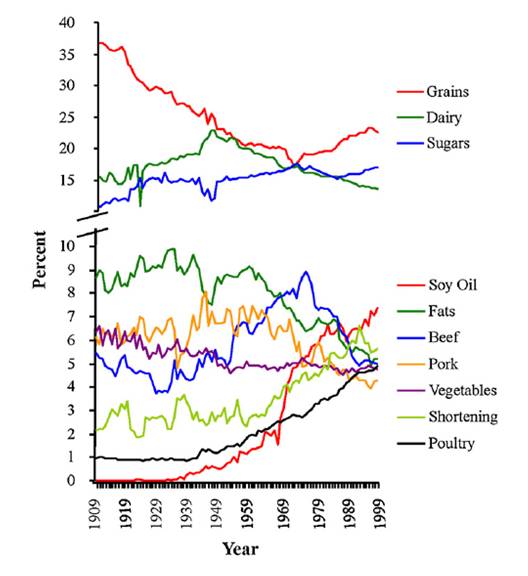 I think this paper is an important piece of the puzzle as we try to figure out what happened to nutrition and health in the US over the last century.
Omega 6 & 3 in nuts, oils etc - harm from too much
Omega 6 and 3 in nuts, oils, meat and fish. Tools to get it right. | Julianne's Paleo & Zone Nutrition Blog
One of the ways our diets have changed dramatically from the diets of our ancestors and even the very recent past is the ratio of Omega 6 to Omega 3 polyunsaturated fatty acids in the food we eat. A huge amount has been written about this subject, dozens of studies have been published. I’m not going into detail, the object here is to provide tools to help you get this balance right. At the end of the page – I’ve posted some links to other interesting blog posts and articles.
Omega 6 and 3 in nuts, oils, meat and fish. Tools to get it right.
You are strict paleo, you eat nothing but meat, seafood, fruit and veggies, nuts and seeds. Your snacks are mainly a handful of almonds. Did you know just 60 grams of almonds gives you all the omega 6 you need – and more may be detrimental?One of the ways our diets have changed dramatically from the diets of our ancestors and even the very recent past is the ratio of Omega 6 to Omega 3 polyunsaturated fatty acids in the food we eat. A huge amount has been written about this subject, dozens of studies have been published. I’m not going into detail, the object here is to provide tools to help you get this balance right. At the end of the page – I’ve posted some links to other interesting blog posts and articles.
PUFA phobia - Matt Sone explains Ray Peat
180 Degree Health: Ray Peat - PUFA
Extract:
 If you know anything about Peat, know that he has a vendetta against polyunsaturated fat – which could very well be his greatest scientific contribution because of the numerous negative actions that excessive polyunsaturated fat intake exerts on human tissues, organs, and glands like the wondrous thyroid.
Extract:
26.6.11
Interview with Ray Peat - link to, and critique of
Interview with Dr. Ray Peat
Interview with Dr. Ray Peat
Ultrasounds Radio with Eluv
http://eluv.podbean.com/2008/10/10/eluv-live-interview-with-dr-ray-peat/
If you have read Eat Fat, Lose Fat, or Wise Traditions journals and website, you know coconut oil is pretty amazing stuff. There are a few other people out there who think so too. Dr. Ray Peat is one of them. Early on in this interview he states that saturated fat is good fat—not something you hear every day, except from us. From there, he focuses in on coconut oil and details some of the benefits, which include regulating metabolism and helping to keep weight under control, controlling estrogen, helping the thyroid issues and even preventing or reducing sunburn damage.
While he gives out some good and intriguing information, one must be careful when listening to him. He mentions that there is no such thing as essential fatty acids. Well, yes there are. Dr. Mary Enig tried to straighten out his confusion on this subject in our Spring 2005 Wise Traditions, but apparently he is still confused. He also says we wouldn’t need vitamin E if we didn’t eat any polyunsaturated fats. Dr. Enig points out that there is some polyunsaturated fat in all food. So even if that is true, it is kind of like saying, “If pigs could fly, [fill in the blank].” If pigs could fly, I would give him a thumbs up for saying things like that. THUMBS DOWN.
This article appeared in Wise Traditions in Food, Farming and the Healing Arts, the quarterly magazine of the Weston A. Price Foundation, Winter 2009.
About the Reviewer
Tim Boyd was born and raised in Ohio, graduated from Case Western Reserve University with a degree in computer engineering, and worked in the defense industry in Northern Virginia for over 20 years. During that time, a slight case of arthritis led him to discover that nutrition makes a difference and nutrition became a serious hobby. After a pleasant and satisfying run in the electronics field, he decided he wanted to do something more important. He is now arthritis free and enjoying his dream job working for the Weston A. Price Foundation.
written by Matt Stone, Mar 08 2010
Interview with Dr. Ray Peat
Ultrasounds Radio with Eluv
http://eluv.podbean.com/2008/10/10/eluv-live-interview-with-dr-ray-peat/
If you have read Eat Fat, Lose Fat, or Wise Traditions journals and website, you know coconut oil is pretty amazing stuff. There are a few other people out there who think so too. Dr. Ray Peat is one of them. Early on in this interview he states that saturated fat is good fat—not something you hear every day, except from us. From there, he focuses in on coconut oil and details some of the benefits, which include regulating metabolism and helping to keep weight under control, controlling estrogen, helping the thyroid issues and even preventing or reducing sunburn damage.
While he gives out some good and intriguing information, one must be careful when listening to him. He mentions that there is no such thing as essential fatty acids. Well, yes there are. Dr. Mary Enig tried to straighten out his confusion on this subject in our Spring 2005 Wise Traditions, but apparently he is still confused. He also says we wouldn’t need vitamin E if we didn’t eat any polyunsaturated fats. Dr. Enig points out that there is some polyunsaturated fat in all food. So even if that is true, it is kind of like saying, “If pigs could fly, [fill in the blank].” If pigs could fly, I would give him a thumbs up for saying things like that. THUMBS DOWN.
This article appeared in Wise Traditions in Food, Farming and the Healing Arts, the quarterly magazine of the Weston A. Price Foundation, Winter 2009.
About the Reviewer
Tim Boyd was born and raised in Ohio, graduated from Case Western Reserve University with a degree in computer engineering, and worked in the defense industry in Northern Virginia for over 20 years. During that time, a slight case of arthritis led him to discover that nutrition makes a difference and nutrition became a serious hobby. After a pleasant and satisfying run in the electronics field, he decided he wanted to do something more important. He is now arthritis free and enjoying his dream job working for the Weston A. Price Foundation.
Comments (6)
 Subscribe to this comment's feed
 ...
written by LA, Feb 23 2011
written by LA, Feb 23 2011
I just heard an interview with Ray Peat on the thyroid today and he sounded tired and not vibrant. It was actually painful and boring to listen and follow him. I love learning about nutrition and health, but I lost interest. He sounded much older than 74. I've met people who were older and sounded more vibrant. Sorry for the negative review, but it's my truth.
-
- -4
-
-

too bad
written by MCA, Feb 02 2011
written by MCA, Feb 02 2011
This site had gone down in quality for a few years, I noticed this when I saw the homeopathy articles and some "spiritual" gobbledeegocks writings. Homeopathy is quack science, any kid in sixth grade who just learned about Avogadro's number can understand that.
This "review" and the other reply about Peat's views on EFA are another low value writing which drag down the average value of the WAP site and philosophy and make someone to doubt the credibility of the whole ...
This "review" and the other reply about Peat's views on EFA are another low value writing which drag down the average value of the WAP site and philosophy and make someone to doubt the credibility of the whole ...
-
- +1
-
-
Poor argument
written by Chris, Oct 30 2010
written by Chris, Oct 30 2010
"Well, yes they are!" is not an argument. You'll have to counter Rays extensive knowledge of biochemistry to make this article less of a joke. To prove that they are not essential, all you have to do is feel what happens when you are able to make significant adaptive changes through intermittent fasting. No EFA's required.
-
- +6
-
-
FRIEND OF Dr. Peat
written by Ed Reich, Oct 26 2010
written by Ed Reich, Oct 26 2010
Greetings,
I am a friend and associate of Dr. Peat. In fact, I am staying at his Mexican home right now.
If you read the articles on Omega 3 and 6 polyunaturated oils,
carefully, on Dr. Peat's website (raypeat.com), I believe taht you will come to the conclusion that the N-3 and N-6 lipids are dangerous. And the Omega 3s are more dangerous that the Omega 6s. Ray Peat is in great health, mentally and physically, and at 74, he looks about 62! The marketing teams of the supplement industry are hard at work deceiving the public about some of
the products they proffer. The guy, above, in particular, needs to bone up on Dr. Peat's great ideas!
I am a friend and associate of Dr. Peat. In fact, I am staying at his Mexican home right now.
If you read the articles on Omega 3 and 6 polyunaturated oils,
carefully, on Dr. Peat's website (raypeat.com), I believe taht you will come to the conclusion that the N-3 and N-6 lipids are dangerous. And the Omega 3s are more dangerous that the Omega 6s. Ray Peat is in great health, mentally and physically, and at 74, he looks about 62! The marketing teams of the supplement industry are hard at work deceiving the public about some of
the products they proffer. The guy, above, in particular, needs to bone up on Dr. Peat's great ideas!
-
- +13
-
-
what an absurd 'review'
written by andrew, Jul 06 2010
Think for yourselfwritten by andrew, Jul 06 2010
Phrases like 'straighten out' and 'still confused' insult Peat's extensive knowledge. He often calls some fats the 'so called essential fatty acids.' Believing that we don't need to consume essential fatty acids, or having a differing opinion, does not make someone 'confused.' You're trying to say that Peat is wrong because Mary Enig says so. Mary Enig's 'scientific' reasoning goes something like this: 'Peat is wrong because I say he's wrong.' Why don't you actually try to discuss the issue. Cite studies that you think demonstrate the necessity of the so called essential fatty acids, or try to point out what you believe to be flaws in his reasoning. You can read more at laproline.blogspot.com.
-
- +20
-
-
written by Matt Stone, Mar 08 2010
Peat is not a bumbling idiot. He too knows that polyunsaturated fats are pervasive. But there are foods that contain tiny traces of polyunsaturated fats, which Peat recommends wholeheartedly, and there are foods with extremely high amounts of polyunsaturated fats, such as those recommended by the Weston A. Price Foundation, such as crispy nuts, lard, goose and duck fat, and poultry skin.
On a WAPF-sytle diet I had many health problems, and I estimate my PUFA intake to have been around 20 grams per day. Since cutting that back to 3 grams per day, my health has improved dramatically.
The longer Enig stays entrentched in the belief that nuts, seeds, cod liver oil, and poultry and pork fat are healthy for Americans, who already have 8 times the tissue concentration of PUFA's that can be considered healthy, the longer they delay what could easily be the most significant thing a person can do to improve their health... Eat 1% of their dietary calories from PUFA's as advised by the world's leading PUFA expert, Dr. William Lands.
On a WAPF-sytle diet I had many health problems, and I estimate my PUFA intake to have been around 20 grams per day. Since cutting that back to 3 grams per day, my health has improved dramatically.
The longer Enig stays entrentched in the belief that nuts, seeds, cod liver oil, and poultry and pork fat are healthy for Americans, who already have 8 times the tissue concentration of PUFA's that can be considered healthy, the longer they delay what could easily be the most significant thing a person can do to improve their health... Eat 1% of their dietary calories from PUFA's as advised by the world's leading PUFA expert, Dr. William Lands.
25.6.11
PUFA 23 times worse for glycation that carbs - Ray Peat
180 Degree Health: Ray Peat - PUFA
"The name, “glycation,” indicates the addition of sugar groups to proteins, such as occurs in diabetes and old age, but when tested in a controlled experiment, lipid peroxidation of polyunsaturated fatty acids produces the protein damage about 23 times faster than the simple sugars do (Fu, et al., 1996). And the oxidation of fats rather than glucose means that the proteins won't have as much protective carbon dioxide combined with their reactive nitrogen atoms, so the real difference in the organism is likely to be greater than that seen by Fu, et al."
"The name, “glycation,” indicates the addition of sugar groups to proteins, such as occurs in diabetes and old age, but when tested in a controlled experiment, lipid peroxidation of polyunsaturated fatty acids produces the protein damage about 23 times faster than the simple sugars do (Fu, et al., 1996). And the oxidation of fats rather than glucose means that the proteins won't have as much protective carbon dioxide combined with their reactive nitrogen atoms, so the real difference in the organism is likely to be greater than that seen by Fu, et al."
Lard - too high in PUFA?
AV-Skeptics : Message: Re: [HED] LARD? too high in PUFA's?
| < Prev Message | Next Message > |
Re: [HED] LARD? too high in PUFA's? Leaf lard, AKA pork leaf fat, would be best, IMO. It's highly saturated like lamb. Regular pork fat is OK in moderation, but I wouldn't cook everything in lard. Nor chicken and turkey fat. If the animals were fed the right way (no nuts or seeds or soybeans or high-PUFA oils), their fat would be lower in PUFAs, but generally red meat and tropical oils are better IMO. Ruminant animals can convert the PUFAs to saturated fats (SFAs). But I eat pork or sausage or bacon occasionally. Several religions do forbid pork and there may be some reasons behind that, but I don't know for sure. I just focus on low-PUFA foods. If you want to experiment, I would eat plenty of starch and unrefined sugar with pork. Ray Peat has said that simple sugars help eliminate PUFAs, and I have seen studies supporting that. Scott and I eat similar to that, like having whole wheat bread with orange juice or honey and some meat, eggs, whole milk, etc. Bruce On Tue, Jun 9, 2009 at 13:16, lite121 <c688217@...> wrote:
|
Omega 6/Omega 3 Ratio - Precious Yet Perilous
Precious Yet Perilous
Written by Chris Masterjohn Phd
Among ten populations studied from five different continents, American adults have the highest blood levels of omega-6 fatty acids and American infants have the lowest blood levels of omega-3 fatty acids.33 Up until the 1930s, Americans consumed on average about 15 grams (one tablespoon) of PUFA per day. Since the 1930s, this value has more than doubled to over 35 grams per day as Americans have increased their intake of vegetable oils rich in the omega-6 linoleic acid (see Figure 2).2 Most of this increase occurred after 1961 when the American Heart Association began recommending that people replace saturated fats with vegetable oils in order to lower cholesterol levels.3
Similar increases in linoleic acid have been shown to decrease the conversion of ALA to longer-chain omega-3 fatty acids such as DHA in humans.49 Human studies tend to look at the fatty acids incorporated into red blood cells, but animal experiments provide much more detailed information about the concentrations of fatty acids in the organs and glands where they are most needed. These experiments show that excesses of linoleic acid do not increase tissue concentrations of arachidonic acid; instead, they replace the true omega-3 DHA with a “fake” omega-6 version of DHA that ordinarily is not found in substantial amounts within the body.50 The main effect of the excess linoleic acid in the standard American diet is thus most likely to be a mild form of DHA deficiency.
The effect of excess linoleic acid is probably most detrimental to infants and young children whose brains are still developing. DHA deficiency during early development may have lasting effects on cognitive and visual function during adulthood. Animal experiments even suggest that these effects are multi-generational, with the DHA concentration of nervous tissue declining with each successive generation.
Even in adulthood, however, dietary fats influence the DHA concentrations of most other tissues. Recent research has shown that our tissues use DHA to synthesize compounds called “resolvins,” which are involved in bringing inflammatory responses to an end when they are no longer needed.51 Sufficient DHA thus allows the immune system to mount a robust inflammatory response against invading pathogens or damaged tissues and to bring the response quickly to an end once the task has been accomplished. Researchers are increasingly discovering that most degenerative diseases involve an element of chronic, low-level inflammation, and the inability to “turn off” important inflammatory processes once they are no longer needed could be part of the problem. DHA deficiency may therefore be at the root of widespread declines in cognitive function, increases in mental disorders and epidemic levels of degenerative disease.
EPA, a precursor to DHA, is an omega-3 fatty acid that accumulates in fish but generally exists in only infinitesimal quantities in mammals and other land animals. Many authors consider EPA an “anti-inflammatory” essential fatty acid, but its “anti-inflammatory” activity is a result of its ability to interfere with arachidonic acid metabolism. The conversion of arachidonic acid to PGE2 in immune cells is an important initiator of inflammation, but it also turns on the genes necessary for the synthesis of compounds that resolve inflammation, some of which are derived from arachidonic acid and others of which are derived from DHA.52 Providing sufficient DHA to allow the synthesis of the full spectrum of inflammation-resolving compounds is a nutritional approach to inflammation. Providing high doses of EPA that interfere with arachidonic acid metabolism, however, is a pharmacological approach, and it is likely to have many adverse consequences.
When Holman and Widmer first discovered the dichotomy between omega-3 and omega-6 fatty acids, they examined nine different tissues in rats on normal lab diets and could not find even a trace of EPA unless they had first induced essential fatty acid deficiency and all its related tissue damage.32 Several years later Holman conducted a study with another colleague showing that ALA aggravated essential fatty acid deficiency; if they gave the animals vitamin B6, however, the rats converted ALA to DHA rather than to EPA and the aggravating effect disappeared.19 More recent studies in humans have provided preliminary evidence suggesting that EPA interferes with growth in infants and immune function in adults, while DHA improves both growth and immune function.53-54
 Figure 2. Increase in American PUFA Consumption
Consumption of polyunsaturated fat in
the United States between 1909 and
2005 based on USDA food disappearance
data. From reference 2,
courtesy of Stephan Guyenet’s Whole
Health Source blog
(used with permission).
John Hughes Bennett, a nineteenth century Scottish physician who traveled the world studying the use of cod liver oil in medicine, wrote in his Treatise on Cod Liver Oil that excessive doses over extended periods of time could cause gastrointestinal problems, excessive menstrual bleeding, itchy skin eruptions and excessive evaporation of water through the skin.55 The last three symptoms seem very much like the hormonal disruptions, hemorrhaging and skin problems known to occur during arachidonic acid deficiency. Had the Burrs looked for gastrointestinal disorders during essential fatty acid deficiency, they probably would have found them. Non-steroidal anti-inflammatory drugs (NSAIDs) work their magic by interfering with the production of PGE2 from arachidonic acid, a characteristic they share with EPA. One of the most common set of side effects associated with these drugs is gastrointestinal disturbances. Four out of ten users of NSAIDs experience symptoms such as heartburn, acid reflux, stomach burning, nausea, or bloating.56 Researchers have used NSAIDs to produce food intolerances in mice that result in a form of severe intestinal damage called villous atrophy that is usually associated with celiac disease,57 suggesting that a deficiency of arachidonic acid or the PGE2 made from it may underlie celiac disease and other food intolerances, perhaps by preventing the gut from forming cellular junctions and thus impairing its integrity. Excessive doses of EPA from fatty fish, fish oil and cod liver oil may contribute to all of these symptoms in susceptible individuals.
Our bodies use the same enzymes to convert EPA to DHA as they use to convert ALA to DHA or linoleic acid to arachidonic acid. The same conditions that reduce the requirement for arachidonic acid and DHA are likely to increase a person’s tolerance for EPA. A diet that excludes refined sugar and rancid vegetable oil, is low in total PUFA content, is adequate in protein and total energy, and is rich in vitamin B6, biotin, calcium, magnesium, and fresh, whole foods abundant in natural antioxidants should not carry any risk of arachidonic acid deficiency when moderate amounts of EPA are consumed. Liberal amounts of egg yolks and liver providing preformed arachidonic acid would provide extra insurance against damage by EPA. Under these conditions, it would be safe to consume cod liver oil—valuable for its abundant provision of DHA, vitamin A and vitamin D—in spite of its EPA content.
Written by Chris Masterjohn Phd
The Omega -6-to -Omega -3 Ratio
An often-cited animal experiment suggested that the ideal ratio of omega-6 linoleic acid to omega-3 ALA is four-to-one, but this experiment injected rats with free fatty acids rather than feeding them dietary oils.47 A more realistic experiment that fed rats a mix of various vegetable oils in a broad range of different proportions showed that a ratio of nine-to-one maximized tissue DHA content just as well as lower ratios.48 The precise ratio is likely to be of much less importance, however, when there is preformed arachidonic acid and DHA in the diet. Nevertheless, people who consume the standard American diet rich in vegetable oils may face adverse consequences from consuming excess linoleic acid and people who consume large amounts of fatty fish, fish oil or cod liver oil may face adverse consequences from consuming an excess of the omega-3 fatty acid eicosapentaenoic acid (EPA).Among ten populations studied from five different continents, American adults have the highest blood levels of omega-6 fatty acids and American infants have the lowest blood levels of omega-3 fatty acids.33 Up until the 1930s, Americans consumed on average about 15 grams (one tablespoon) of PUFA per day. Since the 1930s, this value has more than doubled to over 35 grams per day as Americans have increased their intake of vegetable oils rich in the omega-6 linoleic acid (see Figure 2).2 Most of this increase occurred after 1961 when the American Heart Association began recommending that people replace saturated fats with vegetable oils in order to lower cholesterol levels.3
Similar increases in linoleic acid have been shown to decrease the conversion of ALA to longer-chain omega-3 fatty acids such as DHA in humans.49 Human studies tend to look at the fatty acids incorporated into red blood cells, but animal experiments provide much more detailed information about the concentrations of fatty acids in the organs and glands where they are most needed. These experiments show that excesses of linoleic acid do not increase tissue concentrations of arachidonic acid; instead, they replace the true omega-3 DHA with a “fake” omega-6 version of DHA that ordinarily is not found in substantial amounts within the body.50 The main effect of the excess linoleic acid in the standard American diet is thus most likely to be a mild form of DHA deficiency.
The effect of excess linoleic acid is probably most detrimental to infants and young children whose brains are still developing. DHA deficiency during early development may have lasting effects on cognitive and visual function during adulthood. Animal experiments even suggest that these effects are multi-generational, with the DHA concentration of nervous tissue declining with each successive generation.
Even in adulthood, however, dietary fats influence the DHA concentrations of most other tissues. Recent research has shown that our tissues use DHA to synthesize compounds called “resolvins,” which are involved in bringing inflammatory responses to an end when they are no longer needed.51 Sufficient DHA thus allows the immune system to mount a robust inflammatory response against invading pathogens or damaged tissues and to bring the response quickly to an end once the task has been accomplished. Researchers are increasingly discovering that most degenerative diseases involve an element of chronic, low-level inflammation, and the inability to “turn off” important inflammatory processes once they are no longer needed could be part of the problem. DHA deficiency may therefore be at the root of widespread declines in cognitive function, increases in mental disorders and epidemic levels of degenerative disease.
EPA, a precursor to DHA, is an omega-3 fatty acid that accumulates in fish but generally exists in only infinitesimal quantities in mammals and other land animals. Many authors consider EPA an “anti-inflammatory” essential fatty acid, but its “anti-inflammatory” activity is a result of its ability to interfere with arachidonic acid metabolism. The conversion of arachidonic acid to PGE2 in immune cells is an important initiator of inflammation, but it also turns on the genes necessary for the synthesis of compounds that resolve inflammation, some of which are derived from arachidonic acid and others of which are derived from DHA.52 Providing sufficient DHA to allow the synthesis of the full spectrum of inflammation-resolving compounds is a nutritional approach to inflammation. Providing high doses of EPA that interfere with arachidonic acid metabolism, however, is a pharmacological approach, and it is likely to have many adverse consequences.
When Holman and Widmer first discovered the dichotomy between omega-3 and omega-6 fatty acids, they examined nine different tissues in rats on normal lab diets and could not find even a trace of EPA unless they had first induced essential fatty acid deficiency and all its related tissue damage.32 Several years later Holman conducted a study with another colleague showing that ALA aggravated essential fatty acid deficiency; if they gave the animals vitamin B6, however, the rats converted ALA to DHA rather than to EPA and the aggravating effect disappeared.19 More recent studies in humans have provided preliminary evidence suggesting that EPA interferes with growth in infants and immune function in adults, while DHA improves both growth and immune function.53-54
Figure 2. Increase in American PUFA ConsumptionConsumption of polyunsaturated fat in
the United States between 1909 and
2005 based on USDA food disappearance
data. From reference 2,
courtesy of Stephan Guyenet’s Whole
Health Source blog
(used with permission).
John Hughes Bennett, a nineteenth century Scottish physician who traveled the world studying the use of cod liver oil in medicine, wrote in his Treatise on Cod Liver Oil that excessive doses over extended periods of time could cause gastrointestinal problems, excessive menstrual bleeding, itchy skin eruptions and excessive evaporation of water through the skin.55 The last three symptoms seem very much like the hormonal disruptions, hemorrhaging and skin problems known to occur during arachidonic acid deficiency. Had the Burrs looked for gastrointestinal disorders during essential fatty acid deficiency, they probably would have found them. Non-steroidal anti-inflammatory drugs (NSAIDs) work their magic by interfering with the production of PGE2 from arachidonic acid, a characteristic they share with EPA. One of the most common set of side effects associated with these drugs is gastrointestinal disturbances. Four out of ten users of NSAIDs experience symptoms such as heartburn, acid reflux, stomach burning, nausea, or bloating.56 Researchers have used NSAIDs to produce food intolerances in mice that result in a form of severe intestinal damage called villous atrophy that is usually associated with celiac disease,57 suggesting that a deficiency of arachidonic acid or the PGE2 made from it may underlie celiac disease and other food intolerances, perhaps by preventing the gut from forming cellular junctions and thus impairing its integrity. Excessive doses of EPA from fatty fish, fish oil and cod liver oil may contribute to all of these symptoms in susceptible individuals.
Our bodies use the same enzymes to convert EPA to DHA as they use to convert ALA to DHA or linoleic acid to arachidonic acid. The same conditions that reduce the requirement for arachidonic acid and DHA are likely to increase a person’s tolerance for EPA. A diet that excludes refined sugar and rancid vegetable oil, is low in total PUFA content, is adequate in protein and total energy, and is rich in vitamin B6, biotin, calcium, magnesium, and fresh, whole foods abundant in natural antioxidants should not carry any risk of arachidonic acid deficiency when moderate amounts of EPA are consumed. Liberal amounts of egg yolks and liver providing preformed arachidonic acid would provide extra insurance against damage by EPA. Under these conditions, it would be safe to consume cod liver oil—valuable for its abundant provision of DHA, vitamin A and vitamin D—in spite of its EPA content.
How Essential Are the Essential Fatty Acids ? A More Detailed Look
Precious Yet Perilous
Written by Chris Masterjohn Phd
How Essential Are the Essential Fatty Acids ? A More Detailed Look
The requirement for essential fatty acids is, under most conditions, exceedingly small. This should not be surprising; after all, if we require omega-6 fatty acids because we need enough arachidonic acid to allow our body to convert into signaling compounds as it needs them, then arachidonic acid fills a role similar to that of vitamins A and D. We require several hundred micrograms per day of vitamin D and several milligrams per day of vitamin A. To put this in perspective, we consume proteins, carbohydrates and fats in gram amounts. A microgram is one millionth of a gram and a milligram is one thousandth of a gram. We should therefore expect the requirement for essential fatty acids to constitute an extremely small percentage of our total energy intake.
Researchers who attempted to quantify the essential fatty acid requirement using purified fatty acids showed that just over two percent of calories as linoleic acid was needed to prevent deficiency in growing rats while less than 0.7 percent of calories as arachidonic acid was needed.10 Lower amounts of arachidonic acid may have proven effective had the researchers tested them. The Burrs did not use this approach. They used purified fatty acids to prove the point that the fatty acids themselves were curative, but used whole foods to quantify the requirement. “All workers,” they wrote, “recognize the fact that the acids isolated by the bromination method may not have exactly the same structure that they had in the natural oil.”8 The Burrs showed that the requirement was only 0.4 percent of calories when they used lard to cure the disease in growing rats and that the requirement was only 0.1 percent of calories when they used liver to cure it.7 Liver probably proved more effective than lard both because it is much richer in arachidonic acid and because it is rich in vitamin B6, which greatly enhances the conversion of linoleic acid to arachidonic acid.19
The essential fatty acid requirement seems to be similar in humans. Butter supplying 1.3 percent of calories as PUFA prevented poor growth, scaly skin and increased susceptibility to infections in human infants consuming a formula made partly from skim milk and mostly from corn syrup, but the investigators did not try using smaller amounts.28 The same authors reported that both 1.3 percent and 2.0 percent of calories as purified linoleic acid incorporated into a synthetic fat molecule cured eczema in infants fed the same type of formula.29 The requirement for purified linoleic acid in human infants fed a diet composed mostly of refined sugar is thus similar to the requirement in young, growing rats fed a similarly atrocious diet, which suggests that the essential fatty acid requirement in infants and growing children can be met by a diet providing less than 0.5 percent of calories as PUFA from animal fat, and much less than this if the fat is provided by liver.
One naturally wonders what the essential fatty acid requirement might be in people who are not consuming most of their calories as refined sucrose or corn syrup. In the 1960s, researchers compared the effect of starch-based and sucrose-based diets on PUFA metabolism. Both diets were deficient in essential fatty acids. The starch-based diet contained only 0.003 percent more calories as linoleic acid than the sucrose-based diet, but the rats fed starch had 50 percent more arachidonic acid and 80 percent more linoleic acid in their livers than the rats fed sucrose.18
Similarly, in essential fatty acid-deficient infants fed 80 percent corn oil, replacement of half the corn oil with hydrogenated coconut oil, which is completely devoid of PUFAs, substantially improved their eczema. High-sucrose diets increase lipid peroxidation in rats,30 a process that causes the destruction of essential fatty acids. Reducing refined sugar in the diet is therefore likely to sharply reduce the essential fatty acid requirement. A number of other factors may reduce this requirement as well, including biotin, vitamin B6, calcium, magnesium, avoidance of rancid vegetable oil, sufficient intake of protein and total energy, and a diet rich in fresh, whole foods abundant in natural antioxidants.31
Written by Chris Masterjohn Phd
How Essential Are the Essential Fatty Acids ? A More Detailed Look
The requirement for essential fatty acids is, under most conditions, exceedingly small. This should not be surprising; after all, if we require omega-6 fatty acids because we need enough arachidonic acid to allow our body to convert into signaling compounds as it needs them, then arachidonic acid fills a role similar to that of vitamins A and D. We require several hundred micrograms per day of vitamin D and several milligrams per day of vitamin A. To put this in perspective, we consume proteins, carbohydrates and fats in gram amounts. A microgram is one millionth of a gram and a milligram is one thousandth of a gram. We should therefore expect the requirement for essential fatty acids to constitute an extremely small percentage of our total energy intake.
Researchers who attempted to quantify the essential fatty acid requirement using purified fatty acids showed that just over two percent of calories as linoleic acid was needed to prevent deficiency in growing rats while less than 0.7 percent of calories as arachidonic acid was needed.10 Lower amounts of arachidonic acid may have proven effective had the researchers tested them. The Burrs did not use this approach. They used purified fatty acids to prove the point that the fatty acids themselves were curative, but used whole foods to quantify the requirement. “All workers,” they wrote, “recognize the fact that the acids isolated by the bromination method may not have exactly the same structure that they had in the natural oil.”8 The Burrs showed that the requirement was only 0.4 percent of calories when they used lard to cure the disease in growing rats and that the requirement was only 0.1 percent of calories when they used liver to cure it.7 Liver probably proved more effective than lard both because it is much richer in arachidonic acid and because it is rich in vitamin B6, which greatly enhances the conversion of linoleic acid to arachidonic acid.19
The essential fatty acid requirement seems to be similar in humans. Butter supplying 1.3 percent of calories as PUFA prevented poor growth, scaly skin and increased susceptibility to infections in human infants consuming a formula made partly from skim milk and mostly from corn syrup, but the investigators did not try using smaller amounts.28 The same authors reported that both 1.3 percent and 2.0 percent of calories as purified linoleic acid incorporated into a synthetic fat molecule cured eczema in infants fed the same type of formula.29 The requirement for purified linoleic acid in human infants fed a diet composed mostly of refined sugar is thus similar to the requirement in young, growing rats fed a similarly atrocious diet, which suggests that the essential fatty acid requirement in infants and growing children can be met by a diet providing less than 0.5 percent of calories as PUFA from animal fat, and much less than this if the fat is provided by liver.
One naturally wonders what the essential fatty acid requirement might be in people who are not consuming most of their calories as refined sucrose or corn syrup. In the 1960s, researchers compared the effect of starch-based and sucrose-based diets on PUFA metabolism. Both diets were deficient in essential fatty acids. The starch-based diet contained only 0.003 percent more calories as linoleic acid than the sucrose-based diet, but the rats fed starch had 50 percent more arachidonic acid and 80 percent more linoleic acid in their livers than the rats fed sucrose.18
Similarly, in essential fatty acid-deficient infants fed 80 percent corn oil, replacement of half the corn oil with hydrogenated coconut oil, which is completely devoid of PUFAs, substantially improved their eczema. High-sucrose diets increase lipid peroxidation in rats,30 a process that causes the destruction of essential fatty acids. Reducing refined sugar in the diet is therefore likely to sharply reduce the essential fatty acid requirement. A number of other factors may reduce this requirement as well, including biotin, vitamin B6, calcium, magnesium, avoidance of rancid vegetable oil, sufficient intake of protein and total energy, and a diet rich in fresh, whole foods abundant in natural antioxidants.31
The Perils of PUFA: Oxidative Stress (broken glass analogy)
Precious Yet Perilous
Written by Chris Masterjohn Phd
September 22 2010 15:02
Sinclair’s experience illustrates one of the unique dangers of all essential fatty acids, regardless of their class—their vulnerability to oxidative stress.
 Figure 3. Oxidative Stress and the Shattering of Delicate PUFAs
Compounds with unpaired electrons, called free radicals, are capable of
stealing electrons from, or “oxidizing,” PUFAs. PUFAs are uniquely vulnerable
to oxidation because they are the only fatty acids with two or more double
bonds, and it is the carbon that lies directly between two double bonds that
is vulnerable to oxidation at physiological temperatures. In the figure, a lipid
peroxyl radical (LOO) steals an electron and a hydrogen atom from a PUFA.
b. Having stolen the electron and hydrogen atom, the lipid peroxyl radical becomes
a lipid peroxide (LOOH). The addition of oxygen to the oxidized fatty
acid forms a new lipid peroxyl radical that can oxidize another PUFA (LH).
c. There are now two lipid peroxides, one shown in its chemical structure and
one abbreviated as LOOH. The newly oxidized fatty acid (L•) can now continue
the chain reaction.
d. Many of these oxidized fatty acids will continue to degenerate into smaller
compounds, like a glass that shatters into many pieces. One such compound,
malondialdehyde (MDA), is shown in the figure. MDA is particularly dangerous
because it can leave the membrane and damage proteins, DNA, and
other important cellular structures. This process can be likened to the shattering
of delicate glass, which results in a mess of dangerous shards that must be
properly cleaned up.
Oxidative stress, or lipid peroxidation, shown in Figure 3, can be thought of as the destruction of structurally and functionally important molecules within the body, beginning with the shattering of PUFAs. PUFAs, in this sense, are like delicate glass. Glass performs many useful functions: we use it to protect ourselves and our property from the assaults of raging storms, for the utensils from which we eat and drink, to see when our vision fails, to examine complex specimens whose details we cannot otherwise distinguish with the naked eye, and in many other more sophisticated examples of modern technology. At the same time, glass is delicate and can shatter. When glass shatters, it invariably leaves behind a mess of dangerous shards. Anyone who breaks a glass on their kitchen floor knows to clean up the shards immediately, lest they or their family cut their feet by walking on them. Likewise, when PUFAs shatter they leave behind shards such as MDA, which are capable of damaging proteins, DNA and other structurally and functionally important components of our cells.
The best way to avoid shattering glass is to be careful with how one uses, cleans and stores it. Nevertheless, the danger of breaking glass will increase simply by having too much of it around. Likewise, the consumption of excess PUFAs increases oxidative stress even when the oils are fresh and properly cared for. Consumption of fresh, non-oxidized DHA, EPA or omega-3-rich perilla oil increases markers of oxidative stress in rats.58 Rats fed 30 percent of their diet as corn oil have double the rate of lipid peroxidation, half the aerobic capacity, and 42 percent lower glycogen stores in their heart tissue compared to rats fed an equal amount of coconut oil.59 A randomized, doubleblind, placebo-controlled trial likewise showed that six grams per day of fish oil increased lipid peroxides and MDA in healthy men, regardless of whether they were supplemented with 900 IU of vitamin E (see Figure 4).60
Sinclair might have better replicated the “Eskimo diet” had he sought the guidance of an Eskimo. Arachidonic acid is necessary for sperm production, and the liberal consumption of glands and other organs rich in arachidonic acid may protect the Inuit and Aleut peoples from the high levels of EPA they obtain from fatty fish and marine oils.31 There may be other components of their traditional diets that limit the vulnerability of PUFAs to oxidative stress, such as antioxidants like coenzyme Q10, lipoic acid, and preformed vitamin A found abundantly in organ meats, or other unknown factors. Human studies have generally used alpha-tocopherol, a form of vitamin E, to protect against the oxidation of fish oils within the body, but supplements of pure alpha-tocopherol suppress levels of gamma-tocopherol, a different form of vitamin E with a unique spectrum of antioxidant protection. Some of the main oxidants in human blood, moreover, are water-soluble so PUFAs require water-soluble antioxidants such as vitamin C for protection. Exactly which components of the traditional Inuit diet best protected them from their high intake of fish oils is unclear, but Sinclair’s experience demonstrates the danger of attempting to replicate a particular peculiarity of one group’s traditional diet without replicating the diet as a whole.
 Figure 4. Fish Oil Increased in Lipid Peroxides and MDA in Humans While Vitamin E Had No Effect
A double-blind, randomized, placebocontrolled trial compared six weeks of supplementation with six grams per day of omega-3 fatty acids from menhaden fish oil to supplementation with six grams per day of olive oil, with or without 900 IU per day of vitamin E as synthetic alpha-tocopherol, in healthy men. For each group, the bar on the left represents the change in lipid peroxides, and the bar on the right represents the change in MDA. Asterisks indicate a statistically significant increase over the course of the six weeks. Fish oil supplementation caused a significant increase in lipid peroxides while MDA and vitamin E had no effect. Adapted from the data in reference 60.
Written by Chris Masterjohn Phd
September 22 2010 15:02
The Perils of PUFA: Oxidative Stress
In 1985, the lipid researcher Hugh Sinclair gave a pre-banquet speech on his seventy-fifth birthday before the Second International Congress on Essential Fatty Acids, Prostaglandins and Leukotrienes in London, in which he described the deleterious effects of one hundred days on an “Eskimo diet” of seal blubber and undeodorized mackerel oil. He went on the diet to measure his bleeding time because the weather during a recent trip with several colleagues to northwestern Greenland had curtailed him from measuring the bleeding times of real Eskimos. Despite a daily supplement of vitamin E, his blood and urine levels of malondialdehyde (MDA)—a product of the oxidative destruction of PUFA (see Figure 3d)—rose to fifty times the normal level. Although MDA causes birth defects, Sinclair was not worried about having “misshapen offspring” because his sperm had disappeared.31Sinclair’s experience illustrates one of the unique dangers of all essential fatty acids, regardless of their class—their vulnerability to oxidative stress.
Figure 3. Oxidative Stress and the Shattering of Delicate PUFAsCompounds with unpaired electrons, called free radicals, are capable of
stealing electrons from, or “oxidizing,” PUFAs. PUFAs are uniquely vulnerable
to oxidation because they are the only fatty acids with two or more double
bonds, and it is the carbon that lies directly between two double bonds that
is vulnerable to oxidation at physiological temperatures. In the figure, a lipid
peroxyl radical (LOO) steals an electron and a hydrogen atom from a PUFA.
b. Having stolen the electron and hydrogen atom, the lipid peroxyl radical becomes
a lipid peroxide (LOOH). The addition of oxygen to the oxidized fatty
acid forms a new lipid peroxyl radical that can oxidize another PUFA (LH).
c. There are now two lipid peroxides, one shown in its chemical structure and
one abbreviated as LOOH. The newly oxidized fatty acid (L•) can now continue
the chain reaction.
d. Many of these oxidized fatty acids will continue to degenerate into smaller
compounds, like a glass that shatters into many pieces. One such compound,
malondialdehyde (MDA), is shown in the figure. MDA is particularly dangerous
because it can leave the membrane and damage proteins, DNA, and
other important cellular structures. This process can be likened to the shattering
of delicate glass, which results in a mess of dangerous shards that must be
properly cleaned up.
Oxidative stress, or lipid peroxidation, shown in Figure 3, can be thought of as the destruction of structurally and functionally important molecules within the body, beginning with the shattering of PUFAs. PUFAs, in this sense, are like delicate glass. Glass performs many useful functions: we use it to protect ourselves and our property from the assaults of raging storms, for the utensils from which we eat and drink, to see when our vision fails, to examine complex specimens whose details we cannot otherwise distinguish with the naked eye, and in many other more sophisticated examples of modern technology. At the same time, glass is delicate and can shatter. When glass shatters, it invariably leaves behind a mess of dangerous shards. Anyone who breaks a glass on their kitchen floor knows to clean up the shards immediately, lest they or their family cut their feet by walking on them. Likewise, when PUFAs shatter they leave behind shards such as MDA, which are capable of damaging proteins, DNA and other structurally and functionally important components of our cells.
The best way to avoid shattering glass is to be careful with how one uses, cleans and stores it. Nevertheless, the danger of breaking glass will increase simply by having too much of it around. Likewise, the consumption of excess PUFAs increases oxidative stress even when the oils are fresh and properly cared for. Consumption of fresh, non-oxidized DHA, EPA or omega-3-rich perilla oil increases markers of oxidative stress in rats.58 Rats fed 30 percent of their diet as corn oil have double the rate of lipid peroxidation, half the aerobic capacity, and 42 percent lower glycogen stores in their heart tissue compared to rats fed an equal amount of coconut oil.59 A randomized, doubleblind, placebo-controlled trial likewise showed that six grams per day of fish oil increased lipid peroxides and MDA in healthy men, regardless of whether they were supplemented with 900 IU of vitamin E (see Figure 4).60
Sinclair might have better replicated the “Eskimo diet” had he sought the guidance of an Eskimo. Arachidonic acid is necessary for sperm production, and the liberal consumption of glands and other organs rich in arachidonic acid may protect the Inuit and Aleut peoples from the high levels of EPA they obtain from fatty fish and marine oils.31 There may be other components of their traditional diets that limit the vulnerability of PUFAs to oxidative stress, such as antioxidants like coenzyme Q10, lipoic acid, and preformed vitamin A found abundantly in organ meats, or other unknown factors. Human studies have generally used alpha-tocopherol, a form of vitamin E, to protect against the oxidation of fish oils within the body, but supplements of pure alpha-tocopherol suppress levels of gamma-tocopherol, a different form of vitamin E with a unique spectrum of antioxidant protection. Some of the main oxidants in human blood, moreover, are water-soluble so PUFAs require water-soluble antioxidants such as vitamin C for protection. Exactly which components of the traditional Inuit diet best protected them from their high intake of fish oils is unclear, but Sinclair’s experience demonstrates the danger of attempting to replicate a particular peculiarity of one group’s traditional diet without replicating the diet as a whole.
Figure 4. Fish Oil Increased in Lipid Peroxides and MDA in Humans While Vitamin E Had No Effect A double-blind, randomized, placebocontrolled trial compared six weeks of supplementation with six grams per day of omega-3 fatty acids from menhaden fish oil to supplementation with six grams per day of olive oil, with or without 900 IU per day of vitamin E as synthetic alpha-tocopherol, in healthy men. For each group, the bar on the left represents the change in lipid peroxides, and the bar on the right represents the change in MDA. Asterisks indicate a statistically significant increase over the course of the six weeks. Fish oil supplementation caused a significant increase in lipid peroxides while MDA and vitamin E had no effect. Adapted from the data in reference 60.
Subscribe to:
Posts (Atom)