Showing posts with label food - nuts. Show all posts

8.7.11

Are Nuts And Seeds Healthy?

Are Nuts And Seeds Healthy?
....brief review by Paleo Diet Lifestyle

Conclusion

We learned that even if they are often loaded with vitamins and minerals, most nuts and seeds should be kept to a minimum on a healthy diet for a few main reasons:
  • Most nuts contain lectins that can irritate the gut lining;
  • Most nuts also contain phytic acid that bind to minerals and blocks their absorption;
  • Most nuts are very high in total polyunsaturated fat and in omega-6 fat, two things that should be keept to a minimum;
Nuts like walnuts and pine nuts are some of the worst ones in terms of fatty acid profile.  A few deserve a special mention though:
  • Macadamia nuts, high in monounsaturated fat, healthy even in high amounts;
  • Chestnuts, starchy and very low in polyunsaturated fat, beneficial as a source of healthy carbohydrates;
  • Brazil nuts, high in omega-6 and total PUFA, but also extremely high in selenium and probably useful in small amount to get adequate amounts selenium;
We also learned that we can make the nutrients in nuts and seeds more bioavailable and mitigate the antinutrient properties in them by soaking them in salty water overnight.

26.6.11

Nuts - effect on inflammation, PubMed

The effect of nuts on inflammation. [Asia Pac J Clin Nutr. 2008] - PubMed result

Asia Pac J Clin Nutr. 2008;17 Suppl 1:333-6.

The effect of nuts on inflammation.

Source

Human Nutrition Unit, Department of Biochemistry and Biotech-nology, Faculty of Medicine and Health Sciences, Universitat Rovira i Virgili, C/Sant Llorenc, 21, 43201 Reus, Spain. jordi.salas@urv.cat

Abstract

Inflammation is one of the recognised mechanisms involved in the development of atherosclerotic plaque and insulin resistance. Inflammatory or endothelial markers such as C-Reactive Protein (CRP), Interleukin-6 (IL-6), fibrinogen, Vascular Cell Adhesion Molecule-1 (VCAM-1) and Intracellular Adhesion Molecule-1 (ICAM-1) have been identified as independent predictors of cardiovascular disease (CVD) or diabetes in human prospective studies. Epidemiological and clinical studies suggest that some dietary factors, such as n-3 polyunsaturated fatty acids, antioxidant vitamins, dietary fiber, L-arginine and magnesium may play an important role in modulating inflammation. The relationship observed between frequent nut consumption and the reduced risk of cardiovascular mortality and type 2 diabetes in some prospective studies could be explained by the fact that nuts are rich in all of these modulator nutrients. In fact, frequent nut consumption has been associated with lower concentrations of some peripheral inflammation markers in cross-sectional studies. Nut consumption has also been shown to decrease the plasma concentration of CRP, IL-6 and some endothelial markers in recent clinical trials.
PMID:
18296371
[PubMed - indexed for MEDLINE]

Walnuts and 9 studies on nuts

Primal Wisdom: Paleo Diet Basics: Why I Eat Walnuts

Paleo Diet Basics: Why I Eat Walnuts

Image Source: Mariani Nut

Some contemporary hunter-gatherer tribes displaying a high immunity to diseases of civilization consume fairly large amounts of nuts. Although some nuts richly supply omega-6 fats and an excess intake of corn, soy, or safflower oils rich in these fats may have ill effects, I hesitate to generalize these effects to all whole foods rich in such oils. Since whole foods contain a myriad of compounds, I believe that we have to evaluate each food as a whole, not reduce any food to a predominant nutrient.

The !Kung got up to 50% of their calories from the mongongo nut. The mongongo supplies 57 g fat/100g, and 43% of that fat occurs as PUFA, nearly all linoleic acid (omega-6). Assuming 2000 kcal/d and 1/3 of calories as mongongo, they would get ~16g linoleic/d just from the nuts, then some from game fats.

However, a 100g portion of mongongos also provides approximately 193 mg of calcium, 527 mg magnesium, 3.7 mg iron, 2.8 mg copper, 4 mg zinc, 0.3 mg thiamine, 0.2 mg riboflavin, 0.3 mg niacin, and a stunning 565mg of vitamin E. This very high vitamin E content makes the oil very stable and resistant to oxidation and 'rancidity' for a very long time, in spite of the African heat.

Inland Australian Aborigines consumed considerable amounts of wild walnuts, almonds, candlenut, pine nuts, and even acorns.

I consume fairly large amounts of nuts, particularly walnuts and almonds, more of the former and less of the latter. Walnuts appear to have a number of positive effects on health. I have collected some articles and abstracts of research on the health effects of walnuts. I have not read all of these in full text yet, but a perusal of PubMed shows a clear pattern of independent research on walnuts suggesting significant health benefits.

Seeds and Nuts - soaking

Soaking Seeds and Nuts | Mark's Daily Apple

Of course, the more nuts you eat (as we Primal types are wont to do), the more apparent the situation becomes for those who are sensitive. The offending characters, it seems, are lectins, phytates, and enzyme inhibitors, notorious little “anti-nutrients” that put some people’s stomachs through the ringer. Even if you don’t show obvious symptoms, many argue, you may be compromising nutritional uptake by eating raw nuts.
While roasting nuts can reduce these anti-nutrients and perhaps clear up the problem for some people, it may not do the full job for others. Furthermore, though roasting may disable the anti-nutrients, it doesn’t enhance the bioavailability of nuts’ vitamin and mineral content. As I’ve mentioned in the past, there’s some concern about heat rendering nuts rancid.
I’d definitely recommend soaking for people who have problems digesting nuts and even for folks who don’t. Soaking and rinsing raw nuts more effectively deals with the phytates and enzyme inhibitors than roasting does. Another benefit to soaking is enhanced flavor.
When I make nut butter, I like to soak raw nuts (almonds being my favorite, of course) in some salt water overnight. Some people choose to soak a full 24 hours. Right after they’re done soaking, it’s crucial to thoroughly dry them. The best ways to ensure they’ll dry all the way through is to lay them out in a single, sparse layer in the sun or in a warm oven (lowest possible setting—ideally not more than 120 degrees). If you have a dehydrator or don’t mind investing in one, that’s a good route to go as well.
Seeds and Nuts - soaking

Food - Nuts and Omega 6 Fats

Nuts and Omega 6 Fats | Mark's Daily Apple

Dear Mark: Nuts and Omega-6s

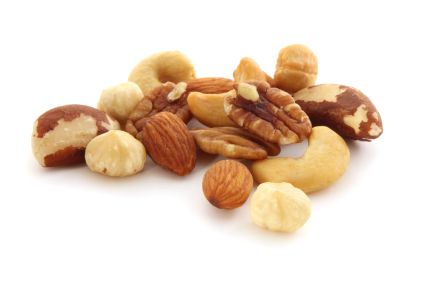
mixednuts

Nuts have gotten a surprising amount of flack as of late. Many nuts have a fairly high PUFA content, and most of that PUFA is Omega-6, which is the bad one. It’s easily oxidized, highly unstable for cooking, usually rancid on the shelf, and, thanks to government farm subsidies and public hysteria over animal fat, it’s in absolutely everything nowadays. We Primal types generally avoid it for good reason, and that tends to influence how we react to the O6 content of nuts. Last week I received this email from a reader:

Food - Nuts and Omega 6 Fats